What Crane-Assisted Tree Removal Actually Means
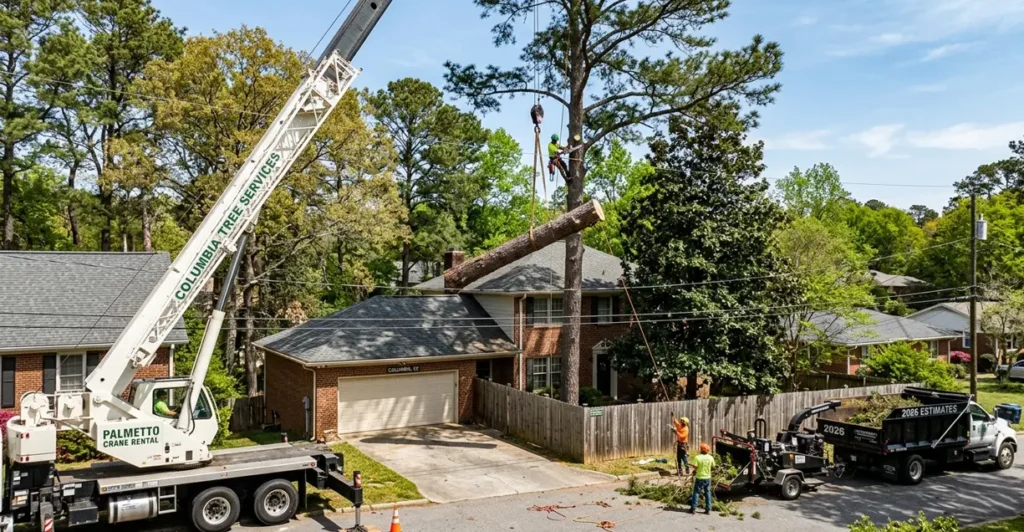
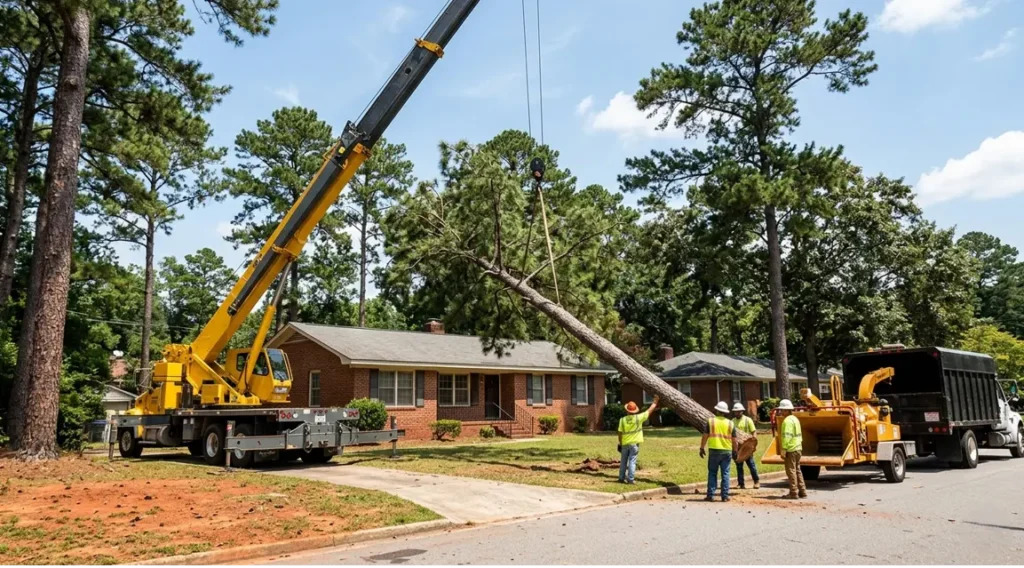
There is sometimes confusion about what crane-assisted removal involves because the term gets used loosely. A true crane-assisted removal uses a hydraulic crane, typically with a lifting capacity of 30 to 200 tons depending on the job, to mechanically control every section of the tree from the moment the arborist makes each cut. The crane does not simply lift the finished sections after they hit the ground. It holds the weight of each section under full tension before the cut is completed, meaning the piece never falls. It is lifted directly upward and away from the structure, yard feature, or hazard zone below.
This is fundamentally different from standard rigging, where a climber ties off sections with rope systems and lowers them gradually using friction and manual control. Rope rigging is the right technique for many jobs and is capable of handling medium-sized trees near structures with precision. But when sections weigh several thousand pounds, when the tree is severely compromised and cannot safely support a climber, or when the structure below leaves zero margin for error, mechanical crane control is the only method that gives crews complete confidence in where every piece goes.
Pioneer Tree Service in Columbia, one of the longest-established tree companies in the Midlands, operates a crane with a 30-ton capacity and 148-foot reach. That reach means the crane can sit on the street or in the driveway while accessing trees deep in your yard, passing over rooflines, pools, and fences without any equipment touching those surfaces at all.
Crane-Assisted Tree Removal Cost in Columbia SC: Full Price Breakdown
Pricing for crane work in Columbia reflects both the crane rental itself and the specialized labor, planning, and coordination involved. Here is how costs break down in 2026:
Crane rental component: The crane itself typically adds $250 to $600 per day to the base removal cost. For projects that extend into a second day, that cost carries over. Some companies own their crane equipment outright, which can make their total pricing more competitive than companies that subcontract crane rental for individual jobs.
Total project cost for medium-large trees (50 to 75 feet): $1,500 to $3,000 This covers a mature loblolly pine or mid-age water oak that requires crane work due to its proximity to a structure. The tree itself is large but not extreme, the crane setup is relatively straightforward, and the job can typically be completed in one day.
Total project cost for very large trees (75 to 100 feet and beyond): $2,500 to $5,000 or more Old-growth water oaks in neighborhoods like Shandon and Heathwood, towering loblolly pines along the Congaree River corridor, and large-canopy American sycamores near older Columbia properties fall into this category. Their sheer weight, trunk diameter, and canopy spread make them genuinely complex crane jobs. Some of these removals require a heavier crane, a larger crew, and a full day of careful sectional work.
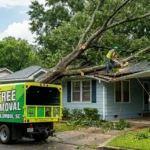
Emergency crane removal after a storm: $2,000 to $7,000 When a large tree is partially down, resting on a roofline, or sitting across a vehicle after a storm event, the complexity escalates considerably. Post-Helene removal crews across Forest Acres and Richland County were handling exactly these scenarios in September 2024. Emergency crane jobs carry premium pricing for after-hours response, heightened crew risk, and the additional coordination required when a tree is no longer in a predictable position.
Multiple trees on the same crane day: Significant per-tree savings One of the best situations for crane-assisted removal cost efficiency is when you have two or more large trees that need this method on the same property. The crane mobilization cost is essentially absorbed across multiple jobs, and the per-tree cost drops noticeably. If you have two trees that each individually would cost $2,500 with crane assistance, bundling them into a single crane day might bring the combined total to $3,500 to $4,000.
When Is Crane-Assisted Removal Actually Necessary in Columbia, SC
This is the question worth spending real time on, because crane recommendation should always follow genuine necessity rather than an upselling opportunity.
Trees Over 70 to 80 Feet Tall
Once a tree exceeds roughly 70 to 80 feet in height, individual sections during conventional top-down removal can weigh several thousand pounds each. Rope rigging systems managed by even experienced ISA-certified climbers face genuine mechanical limits at that scale. A single section of a 90-foot loblolly pine trunk can weigh more than two tons. Controlling that weight with rope tension alone, in a yard with limited drop zones, is a genuine risk to crew and property. Crane assistance removes that risk entirely.
Trees Positioned Directly Over or Against Your Home
In Columbia’s older, established neighborhoods, including Shandon, Elmwood, the Rosewood area, and the streets surrounding the University of South Carolina’s Historic Horseshoe, homes and trees have been growing together for decades. It is not unusual to find a 70-foot water oak whose canopy covers nearly the entire roofline of a two-story house. Removing that tree with conventional rigging requires pieces to pass adjacent to the roof as they are lowered. A crane lifts each section straight up and away, depositing it cleanly in the street or an open drop zone. The roof never comes close to being in the path of a falling section.
Structurally Compromised or Storm-Damaged Trees
When a tree has suffered significant structural damage from a storm, from root failure, or from internal decay caused by fungi like annosum root rot or Ganoderma species that are common in South Carolina’s warm, humid climate, climbing that tree introduces serious risk to the arborist. A crew member climbing a tree with hollow sections or failed root anchorage is placed in genuine danger. A crane-based approach keeps the climber in a safer position and uses the crane as the primary load-bearing mechanism rather than the tree itself.
Hurricane Helene made this scenario intensely real for Columbia homeowners. Trees that had appeared structurally sound were uprooted by wind gusts recorded at 67 mph at Columbia Metropolitan Airport. Many of those trees were left leaning against structures or sitting at precarious angles, making conventional removal methods inappropriate and crane-assisted approaches the only responsible option.
Trees Near Dominion Energy Power Lines
Trees growing into or adjacent to Dominion Energy transmission infrastructure in the Columbia service area require extremely careful removal coordination. When a tree is large enough that sections might contact live overhead lines during descent, a crane provides the directional control needed to lift sections away from the lines rather than lowering them past them. This is a safety necessity, not a preference.
Tight Yards, Pools, and Enclosed Spaces
Properties with pools, detached garages, decorative landscaping, hardscaping, or limited gate access present practical access challenges for conventional equipment. A crane positioned on the street or at the edge of a property can reach 100 feet or more into a backyard without putting any equipment on the landscaping itself. The reduced ground disturbance is actually a genuine cost benefit: you are protecting landscaping and hardscaping features that would otherwise need repair.
How the Crane Removal Process Works Step by Step
Understanding the process helps you evaluate whether a company is doing the job correctly and makes it easier to ask informed questions before signing any estimate.
Site assessment and lift planning: Before a single piece of equipment arrives, a certified arborist walks the property to evaluate the tree’s height, estimated weight, trunk condition, lean angle, canopy spread, and surrounding hazards. The assessment produces a lift plan: where the crane positions, where each section will be lifted and deposited, and the sequence of cuts from crown to base.
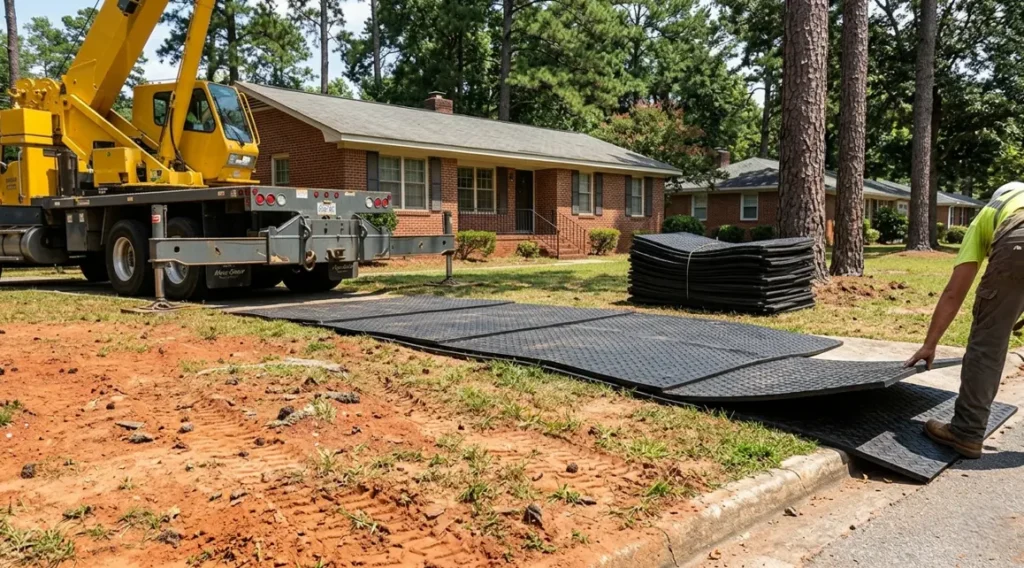
Crane positioning and setup: On the day of removal, the crane arrives first and is positioned for maximum reach and stability. For most residential Columbia properties, this means the crane sits on the street or in the driveway, extending its boom over fences, rooflines, or yard features to reach the tree. Outrigger pads are deployed to distribute the crane’s weight and protect driveway surfaces or pavement.
Rigging the first section: A certified arborist ascends the tree using a climbing system or an aerial lift. At the crown, a rigging sling is attached to the first section that will be cut. The crane takes tension on the line before the chainsaw begins. This is critical. The section is already under full crane control when the cut is made, so it never swings or falls independently.
Sectional removal from crown to base: Working top to bottom, the arborist cuts sections of 8 to 20 feet depending on weight and crane capacity. After each cut, the crane lifts the section clear of the zone below and deposits it in a designated landing area for processing. The crane operator and arborist communicate continuously throughout this sequence.
Stump and final cleanup: Once the trunk is reduced to a stump, the crew processes all debris. Brush is chipped on site, log sections are stacked or hauled depending on your preference, and the work zone is raked and cleaned. Stump grinding is typically offered as an add-on at the time of the estimate. Many homeowners also choose professional stump removal services to completely eliminate the remaining stump, improve curb appeal, and prevent future pest or root issues after crane-assisted tree removal.
Crane Removal vs. Standard Sectional Rigging: Side by Side
Understanding what each method does and does not offer helps you evaluate which is genuinely appropriate for your tree.
Standard sectional rigging with climbing: Appropriate for medium-large trees in yards with adequate drop zones, where sections can be safely lowered adjacent to structures without contact risk. This method is less expensive and entirely appropriate for the majority of large tree removals. An experienced ISA-certified climber with proper rigging equipment handles most trees up to 60 to 70 feet without a crane.
Crane-assisted removal: Appropriate for trees that exceed safe rigging capacity by size, trees whose position eliminates safe drop zones for rope-lowered sections, structurally compromised trees where climbing risk is elevated, and emergency removals where the tree’s current position makes any other approach dangerous. Costs more but eliminates a category of risk that rope rigging cannot address.
The honest answer is that most homeowners dealing with a 40 or 50-foot tree in a Columbia backyard do not need a crane. But for the specific scenarios described above, paying the additional cost is not extravagant. It is the right engineering decision for the job.
Is Crane-Assisted Removal Worth the Cost in Columbia, SC
Let’s answer this directly. For a 90-foot water oak sitting three feet from the roofline of a two-story home in Forest Acres, crane-assisted removal is not just worth the cost. It is the responsible choice, and any company telling you they can handle that tree safely without crane equipment should be viewed with skepticism. The cost of a crane rental and the crew’s time is a fraction of what even minor roof damage costs to repair.
For a 65-foot loblolly pine in the center of a large open backyard in Lexington County with clear drop zones in multiple directions, a crane is probably not necessary. A skilled climber with proper rigging handles that job well, and if a company is insisting on crane equipment for that scenario, the recommendation deserves scrutiny.
The determining question is always whether the removal can be executed safely and without property damage risk using conventional methods. When the answer is no, the crane cost is worth it. When the answer is yes with the right crew and rigging, standard removal is entirely appropriate.
What to Ask Before Hiring a Crane Tree Service in Columbia, SC
Before any company brings a crane to your property, there are several things worth confirming in writing.
Ask specifically why crane assistance is needed for your tree rather than advanced rigging. A legitimate company will give you a clear, site-specific answer. Ask whether the company owns the crane or subcontracts it, since subcontracted equipment adds cost and introduces coordination variables. Ask for documentation of the crane operator’s licensing and confirm the company’s general liability insurance covers crane operations on residential property.
Confirm what the estimate includes: crane rental, crew labor, debris removal, wood chip handling, and stump grinding if applicable. In the Columbia market, some companies quote the crane work separately from removal and cleanup, which can make an initial number seem lower than the final total.
Finally, ask whether the company’s ISA-certified arborists will be on site throughout the job, not just for the assessment. The arborist’s judgment during sectional removal is what makes crane-assisted work precise. Having certified expertise present from first cut to last piece is a meaningful differentiator between quality companies and those simply operating equipment. Homeowners looking for experienced professionals in nearby areas can also learn more about trusted tree removal services in Lexington, SC for safe and technically complex crane-assisted projects.
Crane Tree Removal and Lawn Protection in Columbia, SC
One concern homeowners often raise about crane work is lawn damage from heavy equipment. This is a real consideration for Columbia’s clay-heavy soil, which compresses and ruts easily when wet, particularly in the weeks following storm events.
Reputable companies use ground protection mats, also called outrigger pads and equipment mats, to distribute the crane’s weight across a larger surface area. This significantly reduces the risk of ruts, cracked driveway edges, or compressed turf. If you have recently installed sod, a decorative stone driveway border, or other surface features worth protecting, mention these during the assessment phase so the crew plans crane placement accordingly.
Final Thoughts
Crane-assisted tree removal in Columbia SC, is a specialized service that commands a higher price because it requires specialized equipment, additional planning, licensed crane operators, and coordinated teamwork between the crane operator and the arborist sectioning the tree. For the situations it is designed to handle, it is among the most precise and property-protective methods available in professional arboriculture.
Whether it is worth the cost depends entirely on the specific tree, its location, its condition, and what the alternatives actually look like. For tall, structurally compromised, or tightly positioned trees in Columbia’s established residential neighborhoods, the crane cost is almost always the right investment. For more accessible trees in open yards, standard removal with an experienced ISA-certified crew is entirely adequate and considerably more affordable.
If you are in Columbia, Lexington, Forest Acres, Irmo, Blythewood, Cayce, or anywhere across the greater Midlands area, and you have a large or complex tree that may require crane assistance, Tree Removal Columbia SC Pros provides free on-site assessments and written estimates. Our team evaluates each tree individually and recommends crane-assisted methods only when they are genuinely the appropriate solution. Call (803) 770-6414 to schedule your free consultation.