- 5900 Corley St, Columbia, SC 29212, United States
Tree Removal vs Stump Grinding Costs in Columbia, SC
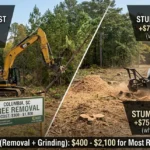
Tree Removal vs Stump Grinding Costs in Columbia, SC typically costs $300 to $1,800 depending on tree size, species, and access. Adding stump grinding to the same job costs an additional $75 to $350 per stump, bringing the combined total to roughly $400 to $2,100 for most standard residential projects. The exact difference between the two options depends entirely on the tree involved, how the stump grinding is priced, and whether you bundle both services together at the time of removal or schedule grinding as a separate visit later. In most cases, bundling saves you money compared to booking them separately.
If you have a loblolly pine, water oak, sweetgum, or any other tree on your Richland County or Lexington County property that needs to come down, understanding what you pay with and without stump grinding, and why that decision matters beyond just the initial cost, is genuinely worth your time before you call anyone for a quote. This guide covers the complete pricing picture for both options in the Columbia area in 2026, the real consequences of leaving a stump behind in South Carolina’s warm and humid climate, and when each option actually makes sense for your specific situation.
- Home
- Blog Details
The Real Cost Difference: Tree Removal vs Stump Grinding Costs in Columbia, SC
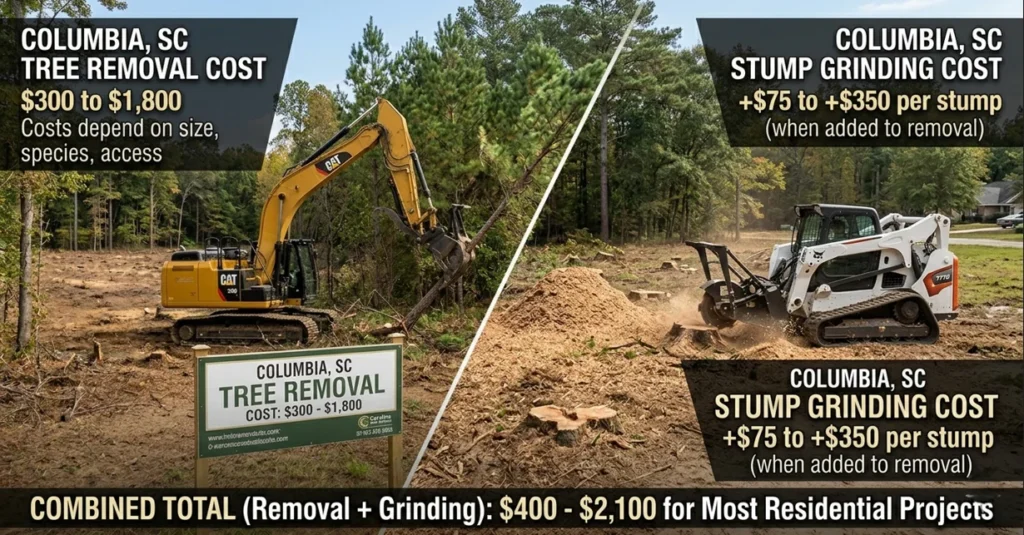
The first thing Columbia homeowners need to understand is that stump grinding is almost never included automatically in a standard tree removal quote. Most companies price the two services separately, which means the quote you receive for removing a tree reflects only the work of cutting the tree down, sectioning it, and clearing the above-ground material. The stump, typically standing 6 to 18 inches above grade after the removal crew leaves, is your responsibility unless you specifically ask for grinding and confirm it is included.
Here is what the realistic combined pricing looks like for the most common tree sizes and species in the Columbia and Midlands area in 2026:
Small trees under 25 feet, removal only: $150 to $450 Small trees under 25 feet, removal plus stump grinding: $250 to $650 Typical stump grinding add-on at this size: $75 to $150
Medium trees 25 to 50 feet, removal only: $400 to $900 Medium trees 25 to 50 feet, removal plus stump grinding: $550 to $1,150 Typical stump grinding add-on at this size: $100 to $200
Large trees 50 to 75 feet, removal only: $800 to $1,500 Large trees 50 to 75 feet, removal plus stump grinding: $950 to $1,800 Typical stump grinding add-on at this size: $150 to $300
Very large trees over 75 feet, removal only: $1,500 to $2,500 and up Very large trees over 75 feet, removal plus stump grinding: $1,700 to $3,000 and up Typical stump grinding add-on at this size: $200 to $500 depending on stump diameter and species
These ranges reflect what reputable Columbia-area companies are quoting in 2026 for standard residential projects. The stump grinding add-on is priced on its own merits regardless of the tree height, because what matters for grinding is the stump diameter at ground level, the species and wood density, and whether surface roots need to be addressed.
How Stump Grinding Is Priced in the Columbia Area
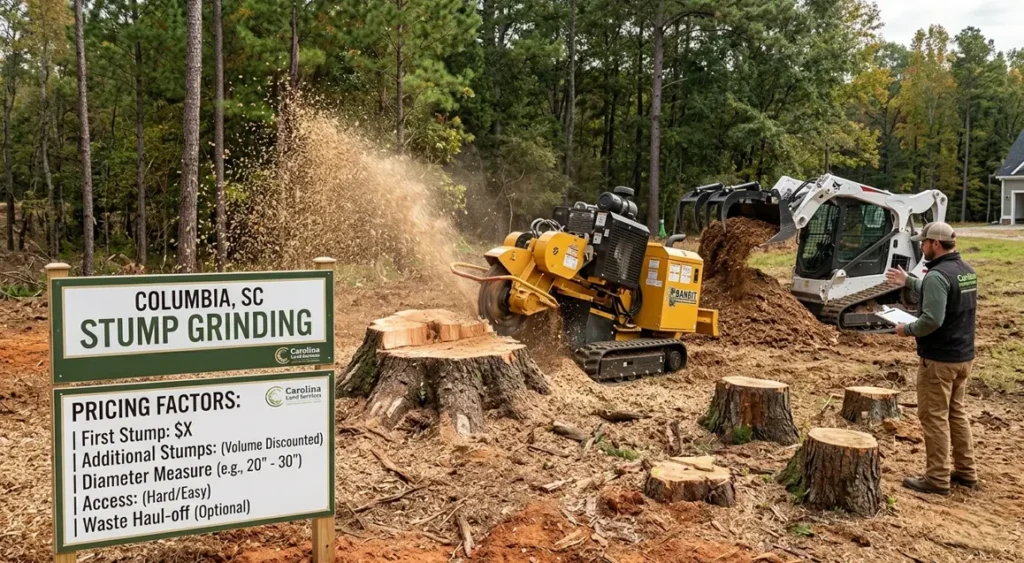
Understanding how companies calculate stump grinding costs helps you evaluate quotes and know whether the number you are being given is reasonable for your specific stump.
Per diameter inch: The most widely used pricing method among Columbia-area stump grinding specialists. Rates run $2 to $5 per inch of stump diameter measured at the widest point at ground level, with a minimum service charge typically between $100 and $150. A 20-inch sweetgum stump at $3 per inch is $60, but the minimum applies, so the actual charge would be $100 to $150. A 36-inch water oak stump at $3 per inch is $108, which clears the minimum, so the per-inch rate applies directly.
Flat rate bundled with removal: When you book stump grinding at the same time as tree removal, many Columbia companies offer a flat add-on rate that can be more favorable than the per-inch calculation alone. The crew is already on site, the mobilization cost is already absorbed into the removal price, and adding grinding to the scope adds labor time but not a separate trip. This bundled scenario is consistently where homeowners get the best combined value.
Separately scheduled grinding after the fact: If you decide after the removal is complete that you want the stump ground, expect to pay a standalone service call that includes a minimum mobilization charge. Booking grinding separately from removal almost always costs more than bundling it at the time of removal, sometimes by $50 to $150 or more, simply because the company has to make a second trip to your property.
Per hour for multiple stumps: When a property has several stumps to be ground in a single visit, some companies shift to hourly pricing at $125 to $200 per hour. For properties with five or more stumps, hourly pricing often works out more economically than per-stump or per-inch rates.
Species Matters: How Columbia's Common Trees Affect Stump Grinding Cost
The type of tree is one of the biggest pricing variables for stump grinding, and Columbia’s Midlands region has a specific mix of species that each presents differently at the grinding stage.
Loblolly Pine: The most commonly removed tree across Richland and Lexington Counties. A softwood with fibrous tissue that a quality stump grinder moves through efficiently. Loblolly pine stumps represent the lower end of grinding cost for their diameter because the material removes quickly. A 20-inch loblolly pine stump typically grinds for $100 to $150.
Water Oak and Willow Oak: These are the most expensive common stumps to grind in the Columbia area. Water oak produces extremely dense, tightly packed hardwood that significantly slows grinding. Their root flares often extend the effective grinding diameter well beyond the visual trunk size. A 28-inch water oak stump that looks manageable can run $200 to $350 to grind properly, particularly in older neighborhoods like Shandon, Heathwood, and Forest Acres where these trees have been growing for decades.
Sweetgum: A moderately dense hardwood that is well known in Columbia for its aggressive surface root systems. The stump itself grinds at moderate difficulty, but sweetgum surface roots frequently spread 10 to 20 feet from the trunk, and chasing those roots to prevent them from continuing to heave your lawn or driveway adds to the total grinding cost. Standard sweetgum stump grinding runs $120 to $250, with root chasing adding $50 to $150 depending on how extensive the spread is.
Bradford Pear: One of the more affordable grinds in the Columbia market. These smaller trees are increasingly being removed across South Carolina due to invasive spread and structural weakness, and their stumps are among the least difficult to handle. Typical cost runs $75 to $150 for most specimens.
Crape Myrtle: Multi-trunk structure changes the grinding calculation. Each trunk is small individually, but a crape myrtle with four or five trunks at the base effectively requires grinding each one separately. Costs run $100 to $200 depending on the number and size of trunks.
American Sycamore: Found in older Columbia neighborhoods and along the Congaree and Saluda River corridors. Sycamores develop wide, flared trunk bases that dramatically increase the effective grinding diameter. A sycamore stump that appears to be 24 inches across may have a ground-level flare that measures 40 or more inches. This is one of the more expensive residential stump grinds in the Midlands area, typically running $250 to $500 or more for large specimens.
When Leaving a Stump Is an Acceptable Option
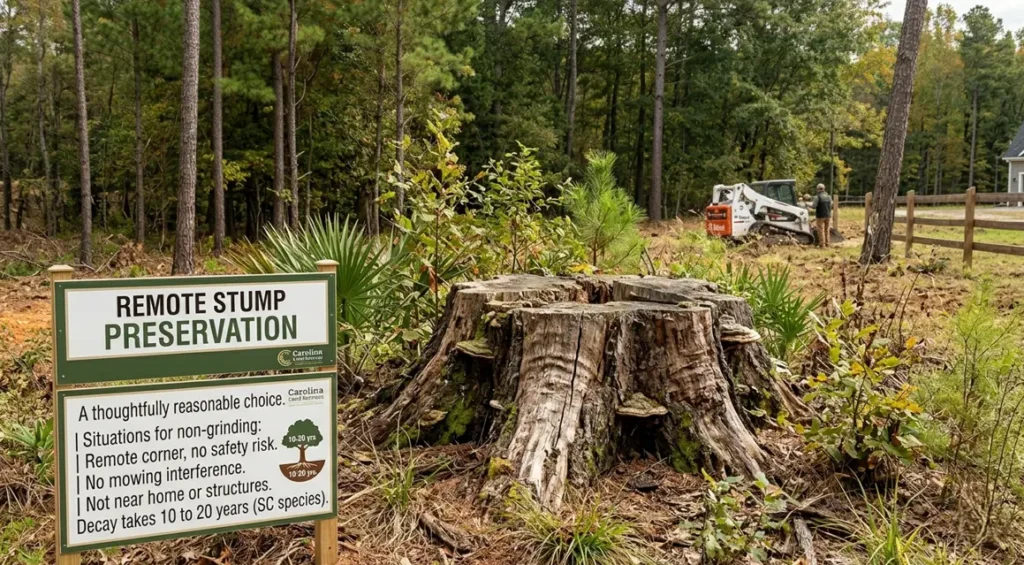
Leaving a stump in place is not always the wrong decision. There are genuine situations where immediate grinding is not necessary, and understanding them helps you make a thoughtful call rather than an automatic one.
If the stump is in a remote corner of your property where it poses no safety risk, causes no interference with mowing, and is not near your home or any structure, waiting on grinding is entirely reasonable. The stump will decay over time, though in South Carolina’s hardwood species, particularly water oak and sweetgum, that process can take 10 to 20 years for a large stump to break down meaningfully.
If your immediate budget is constrained and the tree removal itself is the urgent priority, doing the removal now and scheduling grinding later is a financially sensible approach. Just understand that booking grinding as a separate visit later will cost more than bundling it today.
If you have creative landscaping plans that might incorporate the stump as a planter, garden bed border, or decorative feature, grinding can wait until your landscape vision is clearer. Some Columbia homeowners in neighborhoods like Shandon and Elmwood have turned well-placed stumps into charming garden elements that complement mature landscaping.
Why Leaving a Stump Becomes a Problem Over Time in Columbia SC
The warm, humid subtropical climate of the Midlands makes Columbia a particularly poor place to leave stumps unattended for long periods compared to drier regions of the country. South Carolina’s heat and moisture accelerate the decay process, but they also accelerate every negative consequence that comes with decay.
Termites and Subterranean Insects: This is the most serious concern for Columbia homeowners. Subterranean termites are among the most destructive pests in South Carolina, and they are attracted to decaying wood in exactly the way a rotting stump represents. The issue is not simply that the termites eat the stump. It is that a termite colony established in a decaying stump near your home uses mud tubes to travel underground and can reach your home’s wooden structure before you have any visible evidence of an infestation. Formosan subterranean termites, which are present in Richland and Lexington Counties, are particularly aggressive. Pest control and structural repair from a serious termite infestation can run $2,000 to $8,000 or more, making the $100 to $300 stump grinding cost look very affordable in comparison.
Fungal Disease Spread: Columbia’s humidity creates ideal conditions for fungal pathogens. A decaying stump from a tree that was removed due to fungal issues, such as annosum root rot common in South Carolina loblolly pines, or Ganoderma root and butt rot present in local hardwoods, can harbor those pathogens in the root system long after the stump itself is gone. Those root-borne pathogens can travel through soil connections to neighboring healthy trees on your property. If you are removing a diseased tree and leaving the stump, you may be maintaining an active disease reservoir that threatens other trees in your yard. In cases where fungal compromise is severe enough to affect the tree’s structural stability, hazardous tree removal protocols apply before the stump question even comes into play.
Regrowth and Sucker Shoots: Not every tree species regrows from a stump, but several common Columbia species do. Sweetgum is well known for producing prolific sucker shoots from its root system following removal. Water oak can also send up new growth. These shoots require repeated cutting to keep under control and represent an ongoing maintenance burden rather than a one-time cost. Grinding eliminates this cycle by destroying enough of the stump and root tissue to prevent meaningful regrowth in most species.
Trip Hazard and Liability: A stump in a lawn area, particularly one that becomes obscured by grass growth over time, is a genuine safety hazard. Children playing, adults mowing, and guests visiting your property can all trip over a partially hidden stump. The liability implications of a stump-related injury on your property are worth considering, especially if the stump is in a frequently used area of your yard.
Lawn Mowing Interference: Every mowing session around a remaining stump costs extra time and effort. Mower blades that contact the stump surface can be damaged. The area immediately around the stump tends to become an overgrown patch that looks poorly maintained. Over months and years, this frustration is not insignificant.
The Right Time to Decide: At Removal or After
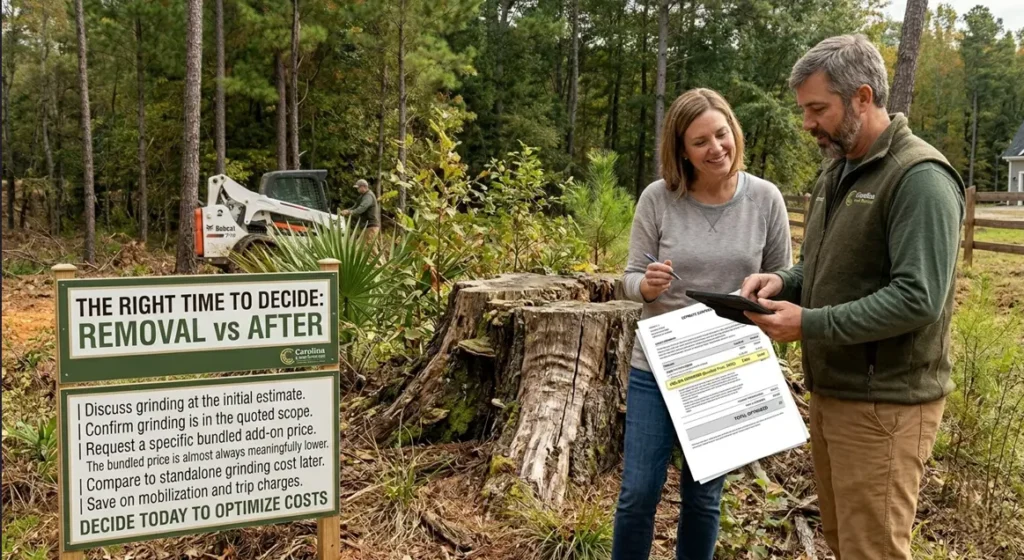
The single most cost-effective moment to add stump grinding to your tree removal project is at the initial estimate stage. When an arborist or tree service estimator visits your property, discuss the stump explicitly. Confirm whether grinding is in the quoted scope. If it is not, ask for a specific add-on price. Compare that bundled add-on price to what standalone grinding would cost later.
In the vast majority of cases in the Columbia market, the bundled price for adding grinding at the time of removal is meaningfully lower than what you would pay for a separate visit later. The mobilization cost, minimum service charges, and second trip logistics all make standalone grinding more expensive per stump than grinding done the same day as removal.
The exception to this is when you genuinely need time to decide what you want to do with the space where the tree stood. If you are weighing landscaping options, planning a patio project, or considering replanting, taking a few weeks to decide whether you want grinding at all, and if so how deep, is entirely reasonable. Just book the grinding explicitly once you have decided rather than assuming it will happen or deferring indefinitely.
Stump Grinding vs. Full Stump Excavation: The Third Option
For most Columbia residential projects, the choice is between leaving the stump and grinding it. But there is a third option worth understanding: full stump excavation, where the entire root ball is removed by an excavator or backhoe rather than ground down in place.
Full excavation costs $200 to $600 or more per stump depending on root ball size, and it requires heavier equipment and more significant yard disruption. It leaves a large hole that needs to be backfilled, regraded, and reseeded. It is the appropriate choice when you are building on the site, pouring concrete, installing an in-ground pool, or planting a replacement tree in the exact same spot where the old tree stood. For larger plots where full root ball removal is part of a broader site preparation plan, this work often falls under the scope of a land clearing project rather than a standard residential stump service.
For any other purpose, stump grinding achieves the practical goals of most homeowners at considerably lower cost and with far less landscape disruption. The roots left underground by grinding decompose over time, a process that South Carolina’s warm, moist soil actually handles relatively efficiently compared to northern climates.
Bundling Multiple Trees and Stumps: Where the Real Savings Happen
If you have more than one tree to remove on your Columbia area property, bundling everything into a single project visit offers the most favorable pricing for both removal and stump grinding. Companies that are already mobilized on your property with a crew and chipper can add additional trees and stumps to the scope at reduced per-unit cost because the fixed overhead of showing up is already covered.
A homeowner removing three trees in a single visit, and adding stump grinding for all three at the same time, will consistently pay less per tree and per stump than a homeowner who books three separate visits. This is worth prioritizing if you have multiple trees that need attention, even if not all of them are equally urgent.
For properties with trees in tight or difficult access positions, large crane assisted removal bundled with same-day stump grinding offers the greatest combined efficiency, since the crane mobilization cost is already covered and adding the grinder to the same visit eliminates a second trip entirely.
Many Columbia-area companies serving Richland County, Lexington County, Forest Acres, Irmo, Blythewood, Cayce, and West Columbia offer bundle pricing for multi-tree and multi-stump projects. Ask specifically about bundle rates when getting any estimate that covers more than one tree.
Practical Scenarios: What You Would Actually Pay in Columbia SC in 2026
To make all of this concrete, here are realistic cost scenarios for common situations Columbia homeowners face:
Scenario A: 50-foot loblolly pine removal in a Blythewood subdivision, open backyard, no nearby structures Removal only: $550 to $750 Stump grinding bundled: $650 to $900 Stump grinding booked separately later: $750 to $1,000 Decision: Bundle at the time of removal unless you have a specific plan for the stump
Scenario B: 65-foot water oak removal in Forest Acres near home foundation Removal only: $1,100 to $1,600 Stump grinding bundled: $1,300 to $2,000 Stump grinding booked separately: $1,400 to $2,200 Decision: Given the proximity to the foundation and water oak’s root aggressiveness, grinding is strongly advisable and bundling saves real money
Scenario C: Three mid-size sweetgums in a Lexington County backyard Removal only for all three: $1,500 to $2,400 All three removals plus stump grinding bundled: $1,800 to $3,000 Decision: Bundling all six services in one visit achieves the best per-unit pricing and addresses all the stump issues before sweetgum sucker growth begins
Scenario D: Small Bradford pear in a West Columbia residential lot, homeowner wants to replant a new tree in the same spot Removal only: $200 to $400 Stump grinding only to standard 8-inch depth: $75 to $130 Full excavation to remove root ball entirely: $200 to $350 Decision: Because replanting in the same spot requires removing the old root ball, full excavation or very deep grinding is appropriate here rather than standard grinding depth.
Final Thoughts
The question of whether to get stump grinding done alongside tree removal in Columbia SC comes down to two things: the practical consequences of leaving a stump in place in South Carolina’s climate, and whether the cost of bundling is worth the price difference compared to leaving the stump or scheduling grinding later.
For the vast majority of Columbia homeowners dealing with trees in active yard space, near structures, or involving species like water oak, sweetgum, or loblolly pine, the answer is yes. The termite risk alone in Richland County’s pest environment makes the incremental cost of stump grinding a sound investment relative to the potential cost of a structural infestation. The savings from bundling at the time of removal compared to a separate visit later make the decision easier still.
If you are in Columbia, Lexington, Forest Acres, Irmo, Blythewood, West Columbia, Cayce, or anywhere across the greater Midlands area, Tree Removal Columbia SC Pros provides fully itemized written estimates covering both tree removal and stump grinding options. Our ISA-certified team will walk you through exactly what each option costs for your specific tree, what the stump will mean for your property long term, and the most cost-effective way to handle both services. Call (803) 770-6414 to schedule your free on-site estimate today.
Share: