Why Emergency Tree Removal Costs More Than Standard Removal
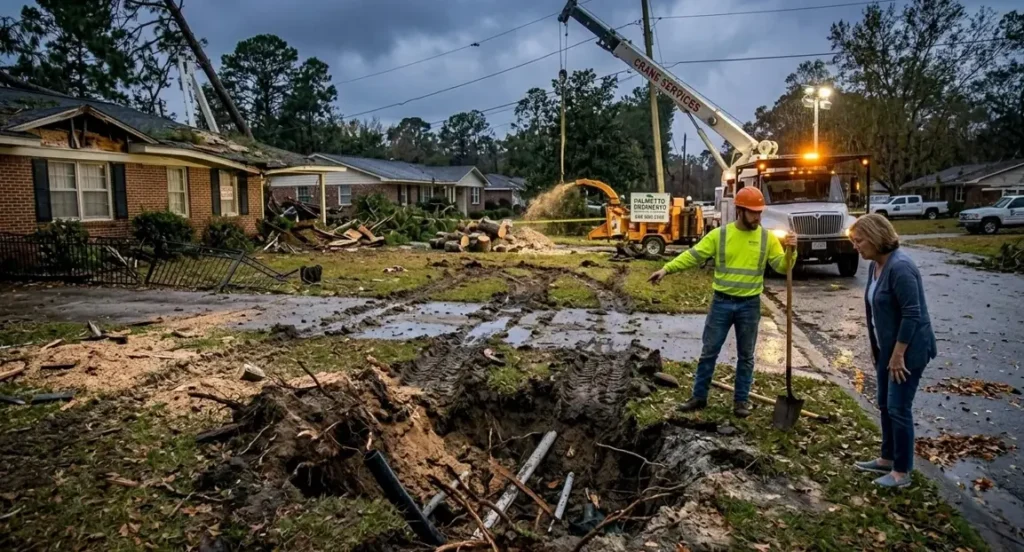
Before breaking down specific prices, it helps to understand why emergency jobs carry a premium over routine tree removal. When a storm hits Columbia, tree companies do not have the luxury of planning. Crews are dispatched at odd hours, often in the dark or in still-wet conditions. Equipment gets mobilized rapidly. Jobs that would normally take a half-day of preparation are handled in minutes.
Three core factors drive emergency pricing above standard rates. The first is urgency and timing. After-hours calls, weekend responses, and holiday dispatches cost more. A call at 11 p.m. on a Sunday after a Dominion Energy transmission line is pinned under a fallen water oak requires a response no matter the hour. The second factor is hazard complexity. Emergency jobs often involve trees that are not cleanly on the ground but are instead wedged against a roofline, resting on a fence, splitting across a car, or tangled in utility lines. These positions require far more planning and controlled technique than a straightforward ground removal. The third is demand surge. When a storm like Helene sweeps through Richland and Lexington Counties and the National Weather Service confirms wind gusts of 67 mph at Columbia Metropolitan Airport, every reputable tree service in the Midlands gets flooded with calls simultaneously. Demand surge alone can push prices 25 to 50 percent above normal in the days immediately following a major weather event.
Emergency Tree Removal Cost in Columbia SC: Price Breakdown by Scenario
Not every storm situation is the same, and the cost varies significantly based on what you are actually dealing with.
Small storm-damaged tree under 25 feet, clear yard access: $350 to $700 This covers ornamental trees, smaller Bradford pears, crape myrtles, or young softwoods that came down in open areas without hitting anything. Response can usually be handled quickly and cleanup is straightforward.
Medium tree 25 to 50 feet, landed in yard without structure damage: $600 to $1,200 A mid-size loblolly pine or sweetgum that uprooted and fell in your backyard after a storm falls here. There is debris to manage, potentially several hundred pounds of wood to section and haul, but no structure complicates the removal.
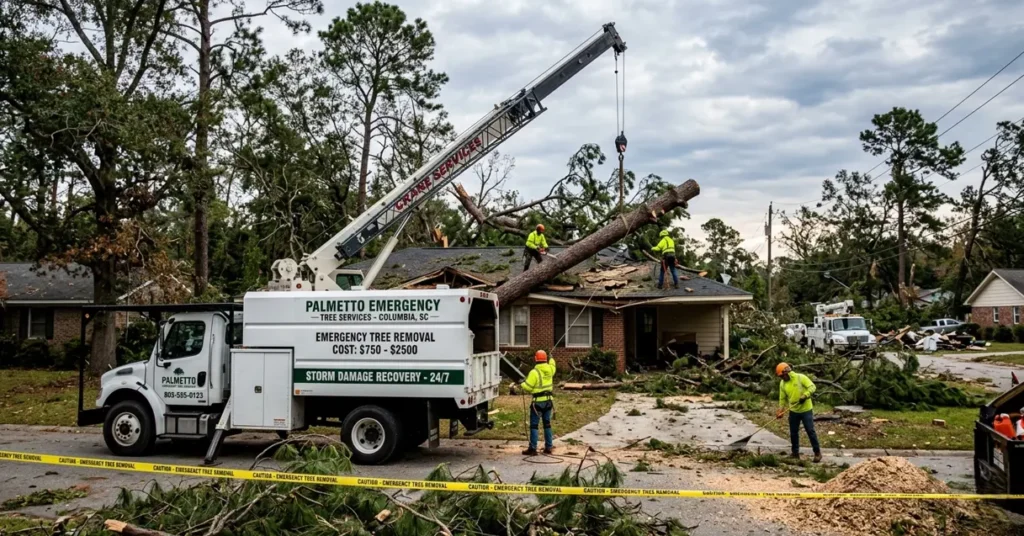
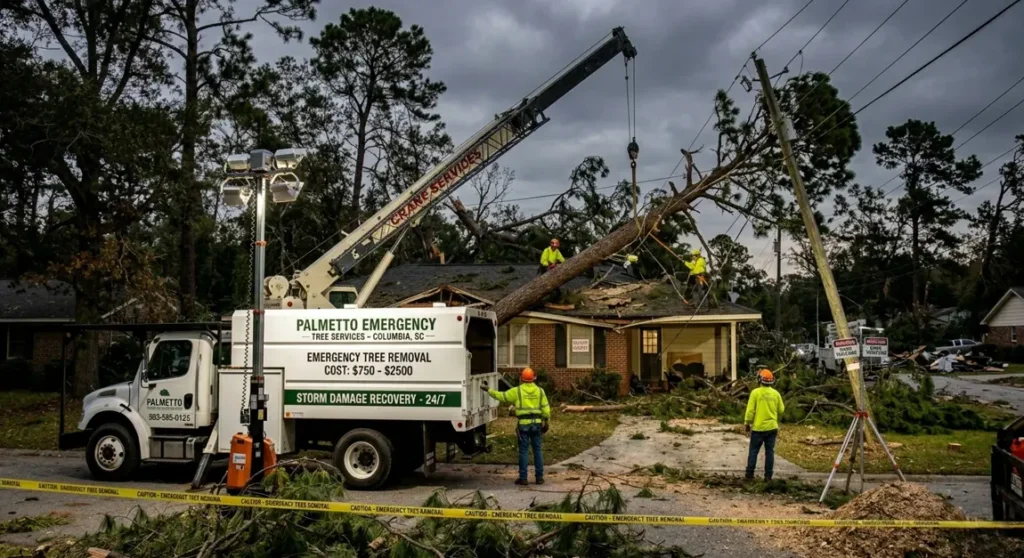
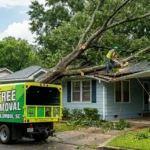
Medium to large tree on roof, fence, or car: $900 to $2,500. This is the most common serious scenario Columbia homeowners face after storms. A water oak or large pine that came down onto a structure requires careful sectional removal to avoid causing additional damage. Crews must work slowly, using rigging to control where each section falls. If the roof has already been breached, additional coordination is needed to protect the interior. This type of job may also require a crane.
Large tree over 60 feet, crane required: $1,500 to $5,000 or more. Very large trees near structures, or trees that cannot be safely removed using ground-based methods, require crane assistance. Crane rental alone adds $250 to $600 per day, and the total project cost reflects the equipment, crew size, and time required. After major storm events in Columbia, crane availability can itself become a bottleneck.
Tree on utility lines, Dominion Energy involvement required: Variable and often shared cost, when a tree falls into live power lines, do not attempt any access yourself. Contact Dominion Energy South Carolina first. The utility company handles the lines; your tree service handles the tree itself once the area is cleared and declared safe. Costs for the tree work in this scenario depend entirely on the extent of the removal needed after lines are addressed.
After-hours and weekend surcharges: $150 to $500 added to base cost, most reputable Columbia tree companies charge additional fees for evening, overnight, weekend, and holiday responses. These are not unusual or unethical. They reflect real labor costs for crews pulled away from their personal time to respond to emergencies.
Columbia SC, Is No Stranger to Storm Damage
Anyone living in the Midlands knows the region is hit regularly by severe weather. Hurricane Helene in September 2024 was a defining event. The storm brought 67 mph wind gusts to Columbia Metropolitan Airport, spawned multiple tornadoes across Richland, Lexington, and surrounding counties, and toppled thousands of trees onto roads, homes, vehicles, and power lines. Forest Acres bore some of the worst tree damage, with cars crushed and residents injured by falling trees. A massive oak came down on the University of South Carolina campus. Over 1.3 million South Carolinians lost power statewide.
That single storm generated more emergency tree removal calls in Columbia than many services see in an entire season combined. Crews from the coast were actually dispatched to the Midlands to help, reversing the typical pattern where inland teams assist coastal communities after hurricanes.
Beyond named storms, Columbia sits in what climatologists recognize as Carolina Alley, one of the country’s four main tornado corridors. Richland and Lexington Counties have a documented history of tornado touchdowns, including the April 2022 outbreak that brought an EF-2 across Lexington County, and the 2004 Tropical Storm Frances event that triggered 47 tornadoes across the state. Summer thunderstorms with straight-line winds capable of toppling mature loblolly pines and weakened water oaks are an annual reality across the Midlands.
Understanding this history is not meant to alarm anyone. It is context for why having a plan for emergency tree removal before a storm hits is one of the most practical things a Columbia homeowner can do.
Many homeowners also prepare in advance by using professional land clearing services in Columbia to reduce risk around their property and minimize storm-related damage before severe weather arrives.
What Happens to Prices During Storm Surge Demand
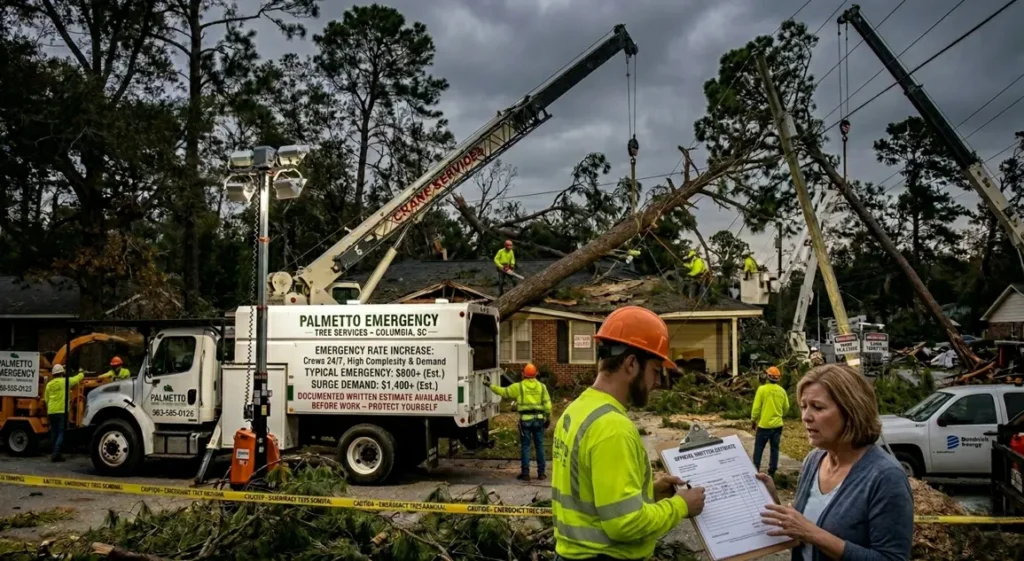
When a significant storm affects the entire Midlands region at once, normal pricing logic shifts. Companies that would ordinarily quote you $800 for an emergency job may be charging $1,400 or more, not because they are gouging you, but because their crews are working around the clock and every job is more complex than usual. Insurance-covered work also floods in simultaneously, which means homeowners paying out of pocket may face longer waits or higher prices simply due to competition for available crews.
There are some protections worth knowing. The South Carolina Department of Consumer Affairs monitors pricing gouging complaints following declared disaster events. If you believe a quote is wildly unreasonable relative to what others are charging, you can document it. That said, emergency premiums are legal and expected. The key is distinguishing between a fair emergency rate and an opportunistic overcharge.
Requesting a written estimate before work begins, even in an emergency, is your most important protection. A legitimate tree service will give you a number upfront.
Does Homeowners Insurance Cover Emergency Tree Removal After a Storm in Columbia, SC
This is the question every homeowner asks immediately after a tree comes down on their property, and the answer has important nuances.
Your standard South Carolina homeowners’ insurance policy is most likely to cover emergency tree removal costs when a tree has fallen because of a covered peril, typically wind, lightning, or the weight of ice and snow, and the tree has damaged a structure on your property. That structure can be your home’s roof, a fence, a detached garage, a porch, or even a blocked driveway that prevents access.
Most standard policies in South Carolina cap tree removal costs at roughly $1,000 to $1,500 per individual tree and up to $3,000 in total per storm event. These limits cover the removal of the tree itself and do not include repair of the structure the tree damaged, which falls under your dwelling coverage.
There are several important scenarios where coverage does not apply. A tree that falls in your open yard without hitting any structure is typically not a covered removal. A tree that was already dead, diseased, or clearly declining before the storm fell is often excluded based on pre-existing neglect. A hazardous tree you knew about and failed to address before it fell into your neighbor’s property may also create a liability situation rather than a standard covered claim.
One detail South Carolina homeowners often miss: if a storm is declared a named weather event, your homeowners policy may apply a separate, larger named-storm deductible. This deductible is calculated as a percentage of your home’s insured value rather than a flat dollar amount, and it can be significantly higher than your standard deductible. Hurricane Helene, for example, qualifies as this type of named event.
If you need to call a tree service before you have had a chance to contact your insurance carrier, document everything thoroughly with photos and video before any work begins. Save every receipt and invoice. Most carriers will reimburse covered costs after the fact as long as you have proper documentation. In urgent situations where the tree poses immediate risk, it’s often safer to proceed with professional help from hazardous tree removal services in Columbia before waiting, especially when safety hazards are present.
What To Do Immediately After a Tree Falls on Your Property in Columbia, SC
The moments right after storm tree damage can feel chaotic, but a clear sequence of steps protects both your safety and your ability to be reimbursed.
First, assess for immediate danger from a safe distance. Do not approach a downed tree that is touching or near power lines. If you see downed lines or suspect contact, call Dominion Energy South Carolina immediately at their outage line and stay well away. No property protection is worth electrocution risk.
Second, photograph everything before any cleanup begins. Document the fallen tree, any structural damage it caused, and the surrounding area. Take photos from multiple angles. If the tree is on your roof, photograph the interior ceiling as well if you can safely access it. These photos are what your insurance adjuster will use to process your claim.
Third, contact your homeowners’ insurance carrier to report the damage and open a claim before hiring anyone. Ask them directly what your policy covers for tree removal and what your deductible situation looks like, given the storm type.
Fourth, call a licensed, insured, and local tree service for an emergency assessment. Get a written estimate. Do not agree to verbal pricing on an emergency job. A company with a real local address, documented insurance, and ISA-certified arborists on staff is always a safer hire than an out-of-town crew working the area after a storm.
If the tree is actively threatening your home with ongoing structural risk, safety comes first. Have the immediate hazard addressed and document it as an emergency response. Then follow up with the full insurance process.
How to Spot Storm Chaser Tree Companies After a Major Weather Event
After every significant storm that hits Columbia, out-of-town crews start appearing in neighborhoods, knocking on doors, and offering discounted services with immediate cash pricing. Some of these operations are legitimate. Many are not.
Warning signs include no verifiable local address, requests for large upfront cash payments before work begins, refusal to provide a written estimate or contract, no proof of general liability insurance or workers’ compensation coverage, and pricing that seems dramatically lower than every other quote you received.
South Carolina does not require a specific state license for tree removal contractors, which means the barrier to entry for anyone with a chainsaw and a truck is essentially zero. After a storm, that reality creates genuine risk for homeowners who are desperate for fast help and not thinking carefully about who they are hiring.
The South Carolina Forestry Commission and the International Society of Arboriculture both maintain searchable directories of certified professionals. ISA membership and certification require ongoing training, demonstrated competency, and adherence to a professional code of ethics. TCIA member companies have additional accountability through that organization’s standards. These credentials are not guarantees, but they are meaningful filters when you are making a hiring decision under pressure.
Can You Speed Up Emergency Response After a Storm
Response time after a major storm event in Columbia is not always within your control, but a few things can help.
Having a relationship with a local tree service before you need emergency help is the most valuable thing you can do. Companies often prioritize existing customers and past clients when scheduling is overwhelmed. If you have had routine trimming or prior removal work done, a quick call to that company puts you ahead in the queue.
Being flexible about timing helps too. If the tree is not an immediate structural threat, being willing to schedule for a day or two after the initial storm rush fades may get you a better rate and a faster-moving crew that is not burned out from back-to-back emergency calls.
Providing clear access to your property before the crew arrives saves time and money. Move vehicles, unlock gates, and clear any portable items that would slow equipment movement.
Finally, having your insurance claim number ready when you call a tree service signals that this is a documented job and speeds the administrative side of the process for both parties. In many cases, homeowners also directly coordinate with trusted local providers like Lexington, SC tree removal services to ensure faster response and smoother claim handling.
How Emergency Tree Removal Affects Your Lawn and Property After a Storm
Once the tree is removed, you are often left with compressed turf from heavy equipment, a large hole from uprooted root systems, scattered wood chip debris, and potentially damaged fencing, landscaping, or hardscaping from the initial fall impact.
Most reputable Columbia tree services include basic debris cleanup and a final site walkthrough as part of their emergency service. Make sure cleanup is clearly defined in any written estimate you sign. Some companies charge separately for hauling away logs, which can add to your total if not discussed up front.
Root ball holes left by uprooted trees can be significant, sometimes several feet wide and deep. Backfilling, regrading, and reseeding those areas is separate from the tree removal itself and is worth asking about as an add-on service while the crew is already on site.
Final Thoughts
Emergency tree removal after a storm in Columbia SC, is one of those costs that arrives without warning and demands action fast. The combination of Columbia’s documented exposure to hurricanes, tropical storms, and the tornadoes that roll through Carolina Alley every spring means this is not a hypothetical scenario for Midlands homeowners. It is a routine reality.
Knowing what prices to expect, understanding your homeowners’ insurance coverage before disaster strikes, having a local tree service contact already identified, and understanding what to do in the first minutes after a tree falls are the practical preparations that make an already stressful situation more manageable.
If you are in Columbia, Lexington, Forest Acres, Irmo, Blythewood, West Columbia, Cayce, or anywhere in the greater Midlands area and need emergency tree removal, Tree Removal Columbia SC Pros responds 24 hours a day, 7 days a week, with ISA-certified arborists and fully insured crews. Call (803) 770-6414 for immediate assistance.