- 5900 Corley St, Columbia, SC 29212, United States
How Tree Size Affects Removal Pricing in the Columbia SC Area
Tree size is the single most important factor in what you will pay for tree removal in the Columbia, SC area. A small ornamental tree under 25 feet tall can be removed for $150 to $450, a mid-size tree in the 25 to 60 foot range typically runs $400 to $1,100, and large trees over 60 feet regularly cost $1,200 to $2,500 or more. But height alone does not tell the whole story. Trunk diameter, canopy spread, species, wood density, and whether a tree requires sectional removal or crane assistance all compound the effect of size on your final bill. Understanding exactly how these size-related variables translate into dollars helps you anticipate costs before calling a single company for a quote.
This guide is written specifically for Columbia-area homeowners dealing with the tree species common to Richland County, Lexington County, and the greater Midlands, including the towering loblolly pines, dense water oaks, and large sweetgums that make South Carolina’s Midlands so distinctive and that drive some of the most varied pricing you will encounter in any tree removal market in the Southeast. For a full overview of local services and coverage across the region, visit our Columbia tree removal service area.
- Home
- Blog Details
Why Size Is the Starting Point for Every Tree Removal Quote
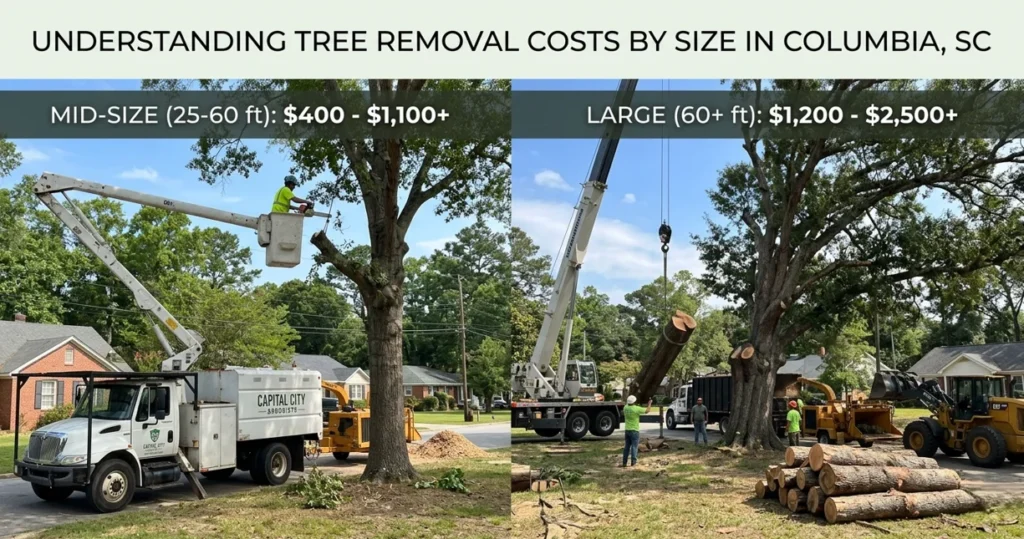
When an ISA-certified arborist walks your property to prepare an estimate, the first thing they do is look up. Height tells them immediately how much vertical work is involved, how many sections will need to be cut, and whether the job can be handled by a climber with rope rigging or whether a bucket truck or crane will need to be scheduled.
After height, they look at the trunk. Diameter at Breast Height, the measurement arborists take at roughly 4.5 feet above ground level, tells them how long each cut will take, how heavy each section will be, and what kind of chainsaw equipment is required. A 12-inch trunk diameter and a 36-inch trunk diameter are not just different numbers on a measuring tape. They represent fundamentally different amounts of wood to cut, different section weights to control on the way down, and different debris volumes to process and haul.
Canopy spread is the third dimension. A tree with a 40-foot canopy radius growing over a house requires far more planning and controlled cutting than a tree of the same height with a tight, upright canopy in an open yard. Width means more sections, more rigging points, and more time.
Every legitimate price you receive from a tree company in the Columbia area begins with these three measurements: height, trunk diameter, and canopy. Everything else, including location, condition, species, and access, modifies the base number that those three dimensions establish.
Tree Removal Cost by Height in Columbia, SC
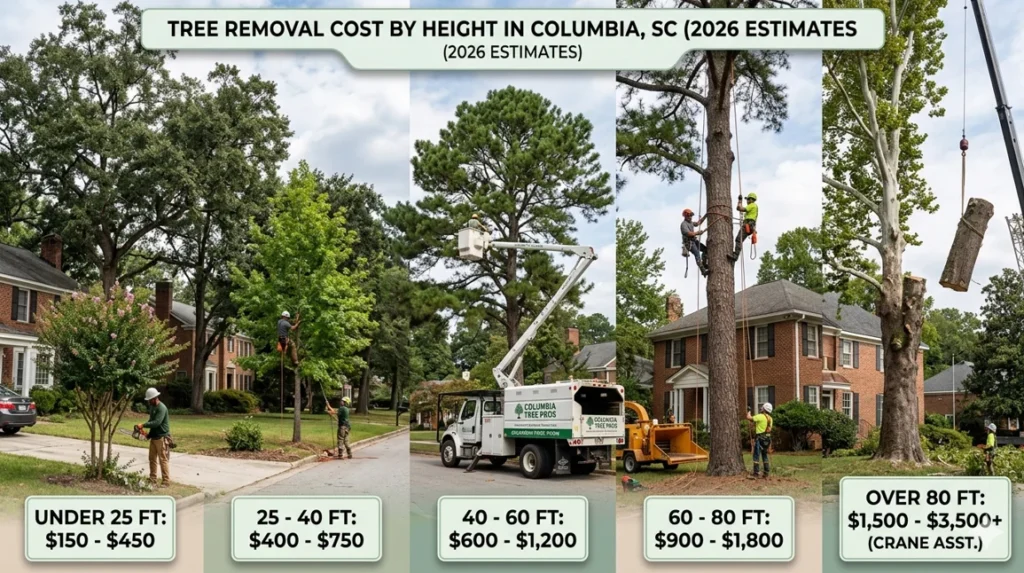
Height is where pricing conversations start, and for good reason. Each additional 10 feet of tree adds meaningfully to the labor, safety equipment, and time required to remove it. Here is how Columbia-area pricing breaks down by height in 2026:
Under 25 feet: $150 to $450. Small trees in this category include young loblolly pines, crape myrtles, ornamental pears, dogwoods, and dwarf tree varieties. Jobs at this scale are typically half-day or shorter with a two-person crew. Standard climbing gear and a chainsaw are sufficient. Cleanup is minimal and the debris haul is manageable.
25 to 40 feet: $400 to $750 Mid-range small trees include mature crape myrtles, Bradford pears, young sweetgums, and smaller water oaks in their first decade of significant growth. This range requires more time and occasionally a bucket truck if the tree is positioned near a structure, but most can still be handled by an experienced climber.
40 to 60 feet: $600 to $1,200 This is the most common size range for trees removed in Columbia’s established residential neighborhoods like Shandon, Rosewood, Forest Acres, and the areas around the University of South Carolina campus. Mature Bradford pears, mid-size loblolly pines, and younger large-canopy oaks fall here. Sectional removal from the top down is standard. Access, lean direction, and proximity to structures start having significant pricing influence at this height.
60 to 80 feet: $900 to $1,800 Large mature trees in this range are common throughout Richland County and older Lexington County neighborhoods. A 70-foot loblolly pine is essentially the default large-tree removal job in the Columbia area. At this height, debris volume is substantial, sectional work takes considerably longer, and proximity to structures must be carefully managed. Prices toward the higher end of this range reflect complex positioning rather than height alone.
Over 80 feet: $1,500 to $3,500 and up At this scale, conventional top-down climbing and rigging reach their practical limits. Trees in this height range, which includes very large loblolly pines along the Congaree River corridor, old-growth water oaks in historic neighborhoods, and mature sycamores near the Saluda River, often require crane assistance. The crane itself adds $250 to $600 per day on top of the base removal cost. Complex jobs involving trees of this height directly over structures can exceed $5,000 for the full project.
Per-foot pricing as a formula: Many Columbia-area tree companies estimate internally using a per-foot calculation. Industry standard puts the cost at roughly $12 to $15 per foot of height as a starting baseline, modified upward for trunk diameter, canopy spread, and site conditions. A 50-foot pine at $13 per foot gives a base of $650, with adjustments added from there. This is a useful way to sanity-check any quote you receive.
How Trunk Diameter Multiplies the Effect of Height
Height without trunk diameter is an incomplete picture. Two trees standing 60 feet tall can carry meaningfully different price tags based purely on how wide they are at the base.
The industry measurement standard is Diameter at Breast Height, abbreviated as DBH. This is the trunk measurement taken at 4.5 feet above grade. For pricing purposes, a larger DBH means more time per cut, heavier sections during removal, more powerful chainsaw chains that wear out faster, more material to chip or haul, and larger stump residue requiring a more powerful grinder.
Trunks under 12 inches DBH: Minimal price impact above the base height cost. These are typically younger trees or naturally narrow-trunked species.
Trunks 12 to 24 inches DBH: This range adds noticeably to labor time per cut and debris volume. Most mid-range trees in Columbia fall here. Expect this to contribute 10 to 20 percent to the base height cost.
Trunks 24 to 36 inches DBH: Larger equipment is needed, cutting time per section increases substantially, and hauling becomes more demanding. Trees at 60 feet with this trunk size often produce debris volumes that fill a full truck or more. This range can add 20 to 40 percent to the base cost.
Trunks over 36 inches DBH: At this scale you are dealing with genuinely massive trees. Old-growth water oaks in neighborhoods like Heathwood and Shandon, some of which have been growing since before the area was developed, can carry trunks approaching four and five feet across. These jobs require heavy-duty chainsaw equipment, often crane assistance for section weight management, and significant debris processing time. The trunk diameter alone at this scale can push a job from a one-day removal into a two-day project.
There is also a useful rough formula arborists use as a quick estimate check: multiply height in feet by $12, add the diameter in inches multiplied by $5, and add a base fee of $200. For a 50-foot pine with a 20-inch trunk that works out to $900. For a 75-foot water oak with a 40-inch trunk, the same formula produces $1,700 before any adjustments for location or access complexity. This is not a substitute for an on-site estimate, but it helps you understand the relationship between size and cost before any company visits, and in some cases, where full removal is required, stump removal services may also be needed to complete the job properly.
Canopy Spread and Why Wide Trees Cost More Than Tall Ones
Canopy spread is the underappreciated third dimension of tree size pricing, and it catches a lot of Columbia homeowners off guard. A tree does not simply need to come down. It needs to come down in a way that avoids everything around it, and the canopy determines how complicated that geometry becomes.
A narrow-canopy 70-foot loblolly pine growing straight up in the center of an open backyard is, relatively speaking, a straightforward job despite its height. A 60-foot water oak with a 50-foot canopy radius that extends over your roofline on one side, your neighbor’s fence on another, and your driveway on a third is a far more complex job despite being shorter. Each branch and limb in the canopy must be rigged and lowered in a controlled sequence. The wider the canopy and the more it overlaps structures or utility lines, the longer the job takes and the more it costs.
Water oaks, willow oaks, and southern red oaks, which are the dominant hardwood species in Columbia’s older residential neighborhoods, are known for their wide spreading canopies. This is part of why mature oaks consistently come in at the higher end of size-adjusted price ranges in the Columbia market compared to loblolly pines of similar height.
How the Same Height Produces Different Prices: Species Comparison in Columbia, SC
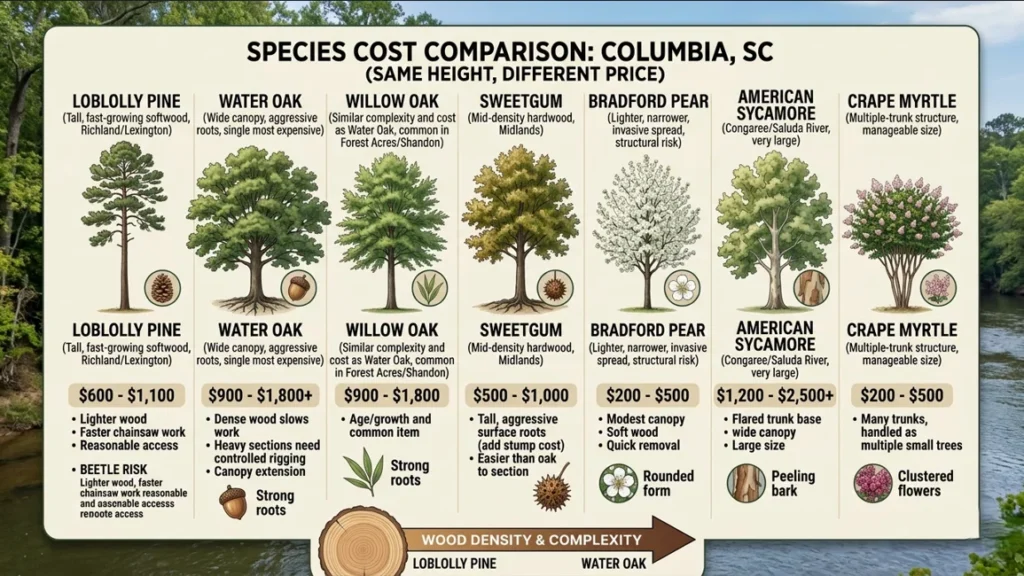
This is where many homeowners are surprised by quotes. Two trees of identical height can carry price tags that differ by 30 to 50 percent based purely on species and the wood density that comes with it.
Loblolly Pine: The most commonly removed tree across Richland and Lexington Counties. A softwood that grows quickly and grows tall, often reaching 60 to 80 feet in 30 to 40 years in the Midlands’ warm climate. Loblolly is lighter than hardwood species for its size, and a well-maintained pine of this height with reasonable access can typically be removed for $600 to $1,100 depending on trunk diameter and location. Beetle-damaged or hollow pines introduce additional handling risk that moves prices toward the higher end regardless of height.
Water Oak: The single most expensive common tree to remove in Columbia on a size-adjusted basis. Water oaks grow wide, carry dense wood, and produce root systems that spread aggressively. A 60-foot water oak costs meaningfully more than a 60-foot loblolly pine. The wood density slows chainsaw work, heavier sections require more controlled rigging, and the canopy typically extends over more of the surrounding yard. Expect water oaks to run $900 to $1,800 or more for mid-to-large size specimens.
Willow Oak: Similar in most respects to water oak in terms of removal complexity and cost. Common in Forest Acres and Shandon where these trees have been growing for 50 to 70 years in some cases.
Sweetgum: A mid-density hardwood very common across the Midlands. Sweetgum grows to significant heights but is somewhat lighter than oak and easier to section. However, sweetgum has one of the most aggressive surface root systems of any tree common to Columbia residential properties, which makes stump work more involved and can add cost to overall job totals. Mid-size sweetgum removal typically runs $500 to $1,000.
Bradford Pear: A lighter, narrower tree that is increasingly being removed across South Carolina due to structural failure risk and invasive spread. These are among the most affordable removals in the Columbia market at $200 to $500 for most specimens. Their relatively modest canopy and soft wood make them quick to remove.
American Sycamore: Found near the Congaree, Saluda, and Broad Rivers and in older neighborhood plantings. Sycamores grow very large and produce wide, flared trunk bases that dramatically increase the effective DBH measurement at ground level even when the upper trunk is relatively narrow. Large sycamores are among the more expensive removals in the Columbia area, often running $1,200 to $2,500 or more for fully grown specimens.
Crape Myrtle: Multiple-trunk structure changes the math entirely. Each trunk is individually manageable in size, but if you have a crape myrtle with six trunks at the base, you effectively have six small tree sections to cut and handle. Most crape myrtle removals run $200 to $500 depending on the number and size of trunks.
The Breakpoints Where Size Changes the Method and the Price Jumps
There are specific size thresholds that represent genuine inflection points in how a tree must be removed and what that costs. Knowing these breakpoints helps you understand why quotes sometimes jump significantly for trees that seem only slightly larger than a previous estimate.
The 30 foot threshold: Below 30 feet, most trees can be felled directly in a controlled direction or handled by a climber without rope rigging for each section. Above 30 feet, full sectional removal becomes more common, and the time required per foot of height increases.
The 60 foot threshold: At 60 feet and above, debris volume becomes a full-day management challenge even for experienced crews. Large-diameter trunk sections cannot simply be dropped and rolled. They need to be lowered in controlled stages, processed with a chipper or buck saw, and either hauled or stacked. The crew size needed for efficient work at this height increases from two to three people at minimum.
The 80 foot threshold: Above 80 feet, the practical limits of rope rigging for managing heavy sections become a genuine safety consideration. Individual trunk sections at the top of an 80 or 90-foot tree can weigh well over a thousand pounds. Crane assistance becomes the responsible choice rather than an optional upgrade in most situations at this height, particularly when the tree is near structures. This is the threshold where the jump from a $1,200 job to a $2,500 or $3,500 job often occurs.
The 24-inch DBH threshold: Below 24 inches of trunk diameter, most chainsaw equipment handles sectioning efficiently. Above 24 inches, cutting time per section increases substantially, heavier-duty bar and chain combinations are required, and the sheer weight of trunk sections demands more mechanical handling. This is the diameter threshold that most commonly adds 20 to 40 percent to base height-calculated prices.
Size and the Complexity Fee: When Location Multiplies the Impact
One of the most important things to understand about size-based pricing is that tree size and positioning combine to produce what contractors often call a complexity multiplier. A 60-foot tree in an open yard costs the base rate. The same 60-foot tree positioned directly over your HVAC unit, with its canopy overlapping your roofline and growing adjacent to your neighbor’s fence, can cost 50 to 100 percent more than the base rate because every section must be rigged and lowered rather than dropped and the margin for error is zero.
This is why two trees of identical size can produce quotes that differ by hundreds of dollars. It is not that one company is overcharging. It is that the complexity of the job is genuinely different based on where the tree is sitting relative to structures, utilities, and open space.
In Columbia’s older established neighborhoods, this situation is extremely common. Shandon, Earlewood, Elmwood, and the streets around Finlay Park and Segra Park are full of mature trees that were planted decades ago without any consideration for how large they would eventually grow relative to the structures around them. A 70-foot water oak that has been quietly growing in a Forest Acres backyard for 50 years may now be essentially surrounded by a two-story home, a fence, an HVAC unit, and a detached garage. That same tree in a rural Lexington County lot with nothing nearby would be a fundamentally different job at a fundamentally different price point.
How Arborists Actually Measure and Quote Size
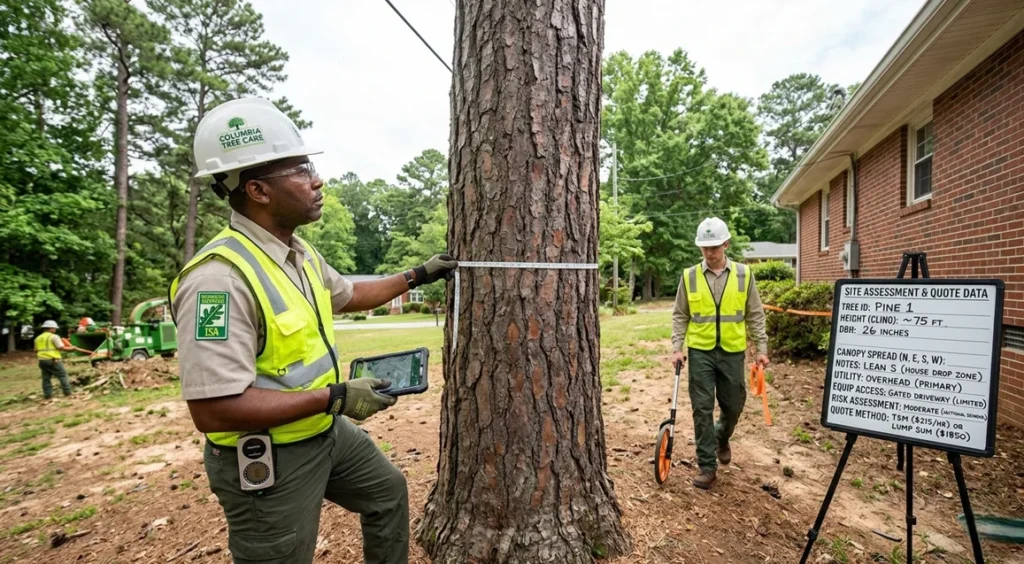
When a legitimate ISA-certified arborist visits your property to prepare a written estimate, they walk the perimeter of the tree, assess its height visually or with a clinometer, measure the trunk at 4.5 feet from the base, and estimate the canopy spread in multiple directions. They are also noting the direction of lean, what structures fall inside the potential drop zone for each section, whether overhead utility lines are present, and how accessible the tree is for equipment.
All of these observations combine with the size measurements to produce the total estimate. Some companies in the Columbia market will also price by hour for certain jobs, typically $190 to $250 per hour for a three-person crew, which is useful for complex removals where the exact time required is difficult to predict from an initial assessment.
The most important thing to ask when you receive a written estimate is what size measurements the company used and how they accounted for the tree’s position relative to structures. Two companies that measure the same tree differently, or that assess the complexity of its positioning differently, will produce quotes that look like pricing discrepancies but are actually reflecting different scopes of work, especially when the job involves unstable or high-risk conditions that may require hazardous tree removal services before standard cutting or cleanup can safely begin.
Size, Weight, and the Debris Math Most Homeowners Overlook
Here is a dimension of tree size that rarely appears in pricing guides but is very real in practice: large trees produce enormous amounts of debris, and managing that debris is labor-intensive and time-consuming regardless of how quickly the actual removal goes.
A 70-foot loblolly pine with a 20-inch trunk produces several hundred cubic feet of wood, bark, and needle material when it comes down. That material needs to be chipped, stacked, or loaded for haul-off. On a job where the tree itself takes three hours to section, debris processing can add another two to three hours to the day’s work. That time is baked into any legitimate quote for a large tree removal.
Homeowners who choose to keep wood as firewood can sometimes negotiate a reduction in total cost by taking ownership of the log rounds. When the crew does not have to load and haul the major trunk sections, that saves time and sometimes truck fees. However, branch material still needs to be chipped or hauled, so the savings are partial rather than total.
Practical Sizing Guide for Common Columbia SC Tree Removal Jobs
To help you apply all of this to real-world situations you might face, here is a practical reference for common tree removal jobs across the Columbia and Midlands area in 2026:
A 30-foot Bradford pear in a suburban Lexington County backyard with good access: $200 to $400
A 50-foot loblolly pine in an open yard in Irmo with no nearby structures: $500 to $750
A 50-foot loblolly pine growing 8 feet from a two-story home in Forest Acres: $800 to $1,300
A 65-foot water oak with a wide canopy in a Shandon backyard with limited equipment access: $1,200 to $1,800
A 70-foot sweetgum in a Blythewood residential subdivision with average access: $900 to $1,400
An 80-foot loblolly pine with a 22-inch trunk in Chapin, open yard, no nearby structures: $1,000 to $1,600
A 90-foot water oak with a 40-inch trunk in Heathwood adjacent to a home, crane required: $2,500 to $4,500
A 100-foot sycamore near the Congaree River with limited access and complex positioning: $3,000 to $6,000 or more
These are realistic ranges based on what Columbia-area companies are actually quoting in 2026. Your specific numbers will vary based on the precise situation, but these give you a useful reference point before the first estimate arrives.
Final Thoughts
Understanding how tree size translates into removal pricing in the Columbia SC area is genuinely useful knowledge for any Midlands homeowner. It helps you interpret quotes you receive, identify when a recommendation seems inconsistent with the job’s actual scope, and budget intelligently for a service that often comes as a surprise expense.
The key takeaway is that size is never just one dimension. Height, trunk diameter, canopy spread, species, and how those size variables combine with the tree’s specific location on your property all feed into the final number. A large tree in an open yard can be affordable. A medium tree in a complex position can be expensive. Understanding why that is true puts you in a better position as a consumer.
If you have a tree on your Columbia, Lexington, Forest Acres, Irmo, Blythewood, or surrounding Midlands property that needs evaluation, Tree Removal Columbia SC Pros provides free on-site assessments with written, transparent pricing. Call (803) 770-6414 to schedule your free estimate today.
Share:
Recent Posts
Gallery