- 5900 Corley St, Columbia, SC 29212, United States
Land Clearing Cost Per Acre in Columbia, SC
Land clearing in Columbia SC costs between $1,500 and $4,500 per acre for most residential and light commercial projects. Lightly vegetated lots with scattered brush and small trees come in toward the lower end of that range, while densely wooded properties carrying mature loblolly pines, large water oaks, and thick Midlands understory vegetation push toward $3,500 to $4,500 per acre or higher. For heavily timbered multi-acre parcels that require extensive equipment time and debris management, total project costs can climb well beyond that range depending on acreage and site conditions.
If you are preparing land for a new home build in Richland County, clearing a rural parcel along the Congaree or Saluda River corridors, or prepping a commercial site in a fast-growing corridor like Blythewood or Chapin, working with an experienced tree removal team can make the entire process safer, faster, and more cost-efficient. This guide covers everything you need to know about how land clearing is priced in the Columbia area in 2026, what drives costs up or down, what methods are used, and what permits you may need before a single machine enters your property.
- Home
- Blog Details
Land Clearing Cost Per Acre in Columbia, SC: Full Price Breakdown
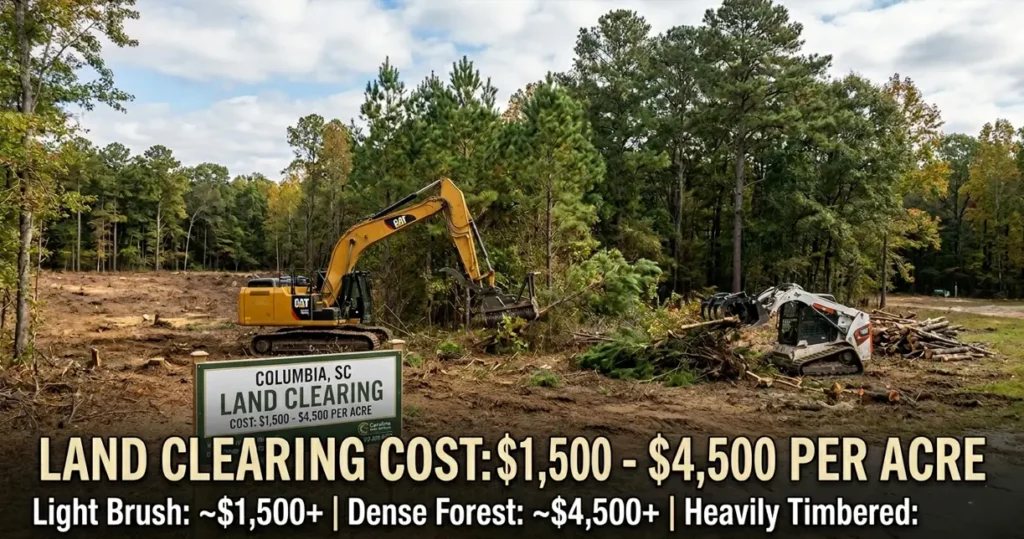
The single biggest variable in land clearing pricing is what is actually on the land. A flat, lightly brushed half-acre residential lot in Lexington County and a two-acre forested parcel thick with 60-foot loblolly pines and sweetgum understory in eastern Richland County are genuinely different jobs that require different equipment, different time commitments, and different disposal strategies.
Here is how pricing breaks down by vegetation density and land type in the Columbia market:
Light clearing, brush, and small trees under 6 inches in diameter: $800 to $1,800 per acre. This covers overgrown residential lots, pasture land that has been neglected for several years, or vacant suburban parcels with primarily shrubs, saplings, and weeds. The work moves quickly with a forestry mulcher or skid steer, and debris is either mulched in place or removed in a single haul-off.
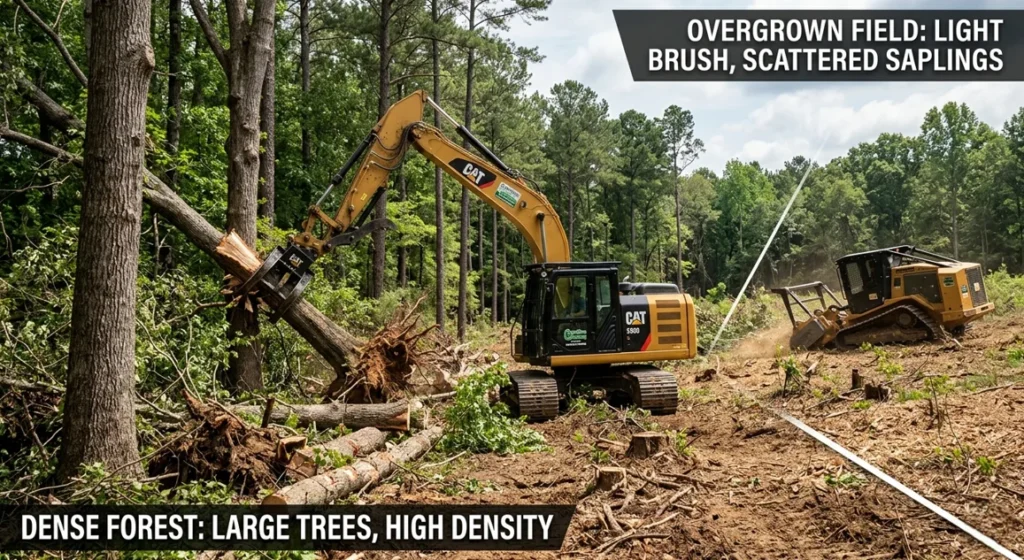
Moderate clearing, mixed vegetation with trees up to 24 inches in diameter: $1,500 to $3,500 per acre. This is the most common scenario for Columbia-area homeowners and builders purchasing raw land or developing existing parcels. Moderate density means a genuine mix of established loblolly pines, mid-age hardwoods, dense understory shrubs like wax myrtle and sweetbay, and ground cover. This level of work requires an excavator, bulldozer, or forestry mulcher with sustained run time per acre.
Heavy clearing, dense forest with large mature trees: $3,000 to $5,000 or more per acre. Properties carrying mature stands of water oak, sweetgum, loblolly pine over 40 feet, and thick multilayer undergrowth require the most intensive clearing effort. This includes most raw wooded land in rural Richland County and the rural portions of Lexington County. Large trees need to be felled, sectioned, and either ground, chipped, or hauled away. Stump grubbing or grinding is often a separate line item.
Lot clearing for new residential construction (typical suburban lot, 0.25 to 0.75 acre): $1,500 to $5,000 total. Most new home sites in Columbia-area subdivisions around Blythewood, Chapin, Lake Murray, and Irmo fall into this range as a complete project cost rather than per-acre pricing. The lot is small enough that per-acre math becomes less relevant than total project complexity.
Hourly rates for complex or selective clearing: $120 to $265 per hour. When a project requires selective clearing rather than full-scale removal, where you want specific trees preserved while others are removed, or when terrain makes per-acre estimation difficult, many Columbia contractors will quote hourly. Projects near the Congaree River floodplain or on sloped terrain in western Lexington County frequently get hourly quotes rather than flat per-acre pricing.
Heavy clearing, dense forest with large mature trees: $3,000 to $5,000 or more per acre. Properties carrying mature stands of water oak, sweetgum, loblolly pine over 40 feet, and thick multilayer undergrowth require the most intensive clearing effort. This includes most raw wooded land in rural Richland County and the rural portions of Lexington County. Large trees need to be felled, sectioned, and either ground, chipped, or hauled away. Stump grubbing or grinding is often a separate line item. If you’re researching how mature tree removal costs compare in different regions, this guide on Tree Removal Oakland Ca offers additional insights into the factors that influence pricing for large tree removals and complex clearing projects.
What Factors Drive Land Clearing Costs in Columbia, SC
Vegetation Density and Tree Size
Nothing affects price more directly than what is growing on the land. A densely wooded parcel carrying large-diameter trees requires more machine hours, more fuel consumption, more operator skill, and more waste management than an overgrown field. Clearing a heavily wooded acre can cost three to five times what clearing a lightly brushed acre costs. Before getting quotes, walk every acre of your property and photograph the vegetation honestly. Contractors who visit and find the land significantly more vegetated than described will revise their estimates accordingly.
Loblolly pine is by far the most common large tree cleared on Columbia-area properties. Fortunately for budgets, it is a softwood that mills through equipment relatively efficiently. Water oak, cherrybark oak, and sweetgum are denser and take longer to process. Properties with heavy hardwood stands cost more to clear than pine-dominated parcels of equal density.
Terrain and Topography
Columbia and Richland County sit primarily on flat to gently rolling terrain characteristic of South Carolina’s Midlands region. That works in landowners’ favor cost-wise. However, properties in the western portions of Lexington County closer to the fall line, parcels with creek drainages cutting through them, and low-lying land near the Congaree, Saluda, and Broad Rivers can present challenging terrain for heavy equipment. Steep slopes reduce equipment efficiency and slow the pace of clearing. Properties with drainage ditches, wet areas, or significant grade changes also require more planning and can push costs toward the higher end of any range.
Site Accessibility
Can an excavator and bulldozer drive directly onto your property from a public road, or does equipment need to push through an overgrown entry? Is there an existing driveway or cleared access lane, or will the crew need to create access before actual clearing begins? These questions matter because mobilizing equipment onto a property with no access point takes additional time and may require a separate site access charge on top of the clearing quote.
For properties in rural Richland County, eastern Lexington County, and the farming communities around Gaston, Hopkins, and Eastover, access considerations can add meaningful cost to otherwise straightforward clearing jobs. especially when storm damage or hazardous trees require fast response emergency tree removal services before land clearing equipment can safely enter the site.
Disposal Method and Debris Management
What happens to the trees, stumps, brush, and debris after clearing is one of the most significant cost variables, and one of the most commonly overlooked when comparing quotes.
The main disposal options in the Columbia area are mulching in place via forestry mulching equipment, chipping and leaving chips on site, hauling debris off site to a disposal facility, and controlled burning where local regulations permit. Each has meaningfully different cost implications.
Haul-off is the most expensive option because it adds truck time, fuel, and disposal fees on top of the clearing labor itself. On-site mulching via a forestry mulching machine is the least expensive because no material leaves the property and no disposal fees apply. Understanding which method is included in any quote you receive is essential to making accurate cost comparisons.
Columbia’s Unique Soil and Proximity to Wetlands
Columbia sits at the geological transition zone between the Piedmont and Coastal Plain, meaning soils across Richland and Lexington Counties vary considerably. The sandy Coastal Plain soils east of Columbia drain well and are generally workable year-round. The clay-rich Piedmont soils in the western portions of the service area become notably difficult for heavy equipment during wet periods, which in the Columbia area means the wetter months from December through March.
Properties near the Congaree, Saluda, and Broad Rivers, and parcels with wetland areas regulated by the South Carolina Department of Health and Environmental Control (DHEC), introduce additional cost considerations. Wetland buffers may restrict how close clearing equipment can operate, and any land clearing that affects regulated wetlands requires appropriate permits before work begins. Violations of DHEC wetland regulations can result in significant fines and mandatory restoration orders, making pre-project wetland delineation genuinely worth the cost.
Land Clearing Methods Used in Columbia, SC
Understanding the different methods helps you ask the right questions and evaluate which approach makes the most sense for your specific property and end goal.
Forestry Mulching
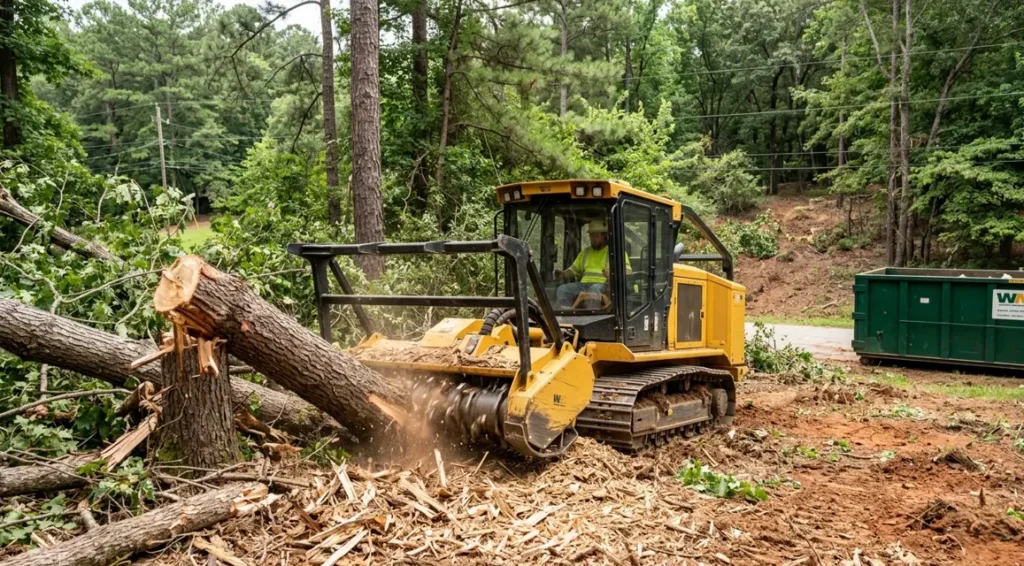
Forestry mulching has become the dominant choice for land clearing across Richland and Lexington Counties over the past decade for good reason. A single specialized machine cuts, grinds, and mulches trees and brush simultaneously, leaving a blanket of wood chip material on the ground. Nothing is uprooted, the topsoil layer is not disturbed, and no debris leaves the property. The resulting mulch layer reduces erosion, retains moisture, and decomposes over time to add organic matter back to the soil.
For most residential lot clearing in Columbia, forestry mulching is the most cost-effective and environmentally sensible approach. It typically costs $1,500 to $3,500 per acre depending on vegetation density, and because no haul-off is required, that number is often the final number. It also requires fewer permits than traditional excavation-based clearing methods.
The limitation of forestry mulching is that it cannot remove large stumps and root systems below grade. If you need a fully graded building pad or need to remove large stump root balls entirely, an excavator or bulldozer will also need to be brought in.
Excavator and Bulldozer Clearing
Excavator and Bulldozer Clearing
Traditional clearing with an excavator and bulldozer pushes trees over, uproots stumps, and piles material for burning or haul-off. This method is still appropriate for large-scale commercial clearing, for properties where stumps need to be fully extracted for construction, and for parcels that need grading work performed simultaneously with clearing.
The drawbacks are higher cost due to debris management, more significant topsoil disruption, and additional permitting requirements in some cases. For a residential lot being prepped for new construction, a combination approach using forestry mulching for vegetation followed by excavator work on stumps and grading often produces the best outcome. When individual trees need to come down before the heavier equipment moves in, felling is typically handled by a professional tree removal crew trained in safe directional cutting around structures, fences, and utility lines.
.
Selective Clearing
When a property owner wants to clear specific areas while preserving trees in others, a selective approach is used. This is common for properties near Lake Murray, along the Saluda River corridor, and in established neighborhoods where homeowners want to open up a specific area for a driveway, outbuilding, or garden while keeping mature hardwoods intact. Selective clearing is typically priced hourly because the work requires more operator judgment and precision than full clearing, and per-acre pricing does not accurately reflect the variable time requirements.
Brush Clearing Only
For properties that have overgrown vegetation but no significant trees, brush clearing is substantially less expensive than full clearing. Brush removal using a forestry mulcher or brush hog can run as low as $300 to $800 per acre for light material, making it one of the more affordable land management services available. Many Columbia-area property owners dealing with overgrown fields, reclaimed pasture, or neglected residential lots use brush clearing as a maintenance service to keep the land usable without the full cost of complete clearing.
Additional Costs Beyond Per-Acre Clearing
The per-acre clearing price is rarely the final number. Several additional line items appear on most land clearing projects in Columbia and are worth budgeting for separately.
Land grading and leveling: After clearing, if you are preparing the site for construction, grading the surface to create a level building pad and establish proper drainage is typically a separate cost. Land grading in the Columbia area runs roughly $1,000 to $5,000 for a standard residential lot, depending on the amount of cut and fill required. Contractors like R and T Grading, Bright LLC, and County Line Land Management are established Columbia-area companies that handle grading work after clearing.
Stump removal: If forestry mulching is used, stumps are ground and mulched but not extracted. If full root ball extraction is needed for the building pad or below-grade construction, stump removal is quoted separately and costs roughly $75 to $400 per stump, depending on size.
Erosion control: The South Carolina Department of Health and Environmental Control and Richland County both have stormwater management requirements that apply to clearing projects over a certain acreage threshold. Installation of silt fences, erosion blankets, or other best management practices adds $500 to $2,000 or more to total project cost but is often legally required, particularly for commercial or large-scale residential development projects.
Surveying and geotechnical testing: If you do not have an accurate survey of your property boundaries, clearing crews cannot confirm exactly where your line is. A land survey for a typical Midlands residential parcel costs $300 to $750. For lots with complex boundaries or multiple easements, that number can be higher. Geotechnical soil testing, required before construction on some sites with uncertain soil bearing capacity, runs $800 to $1,800.
Haul-off and disposal fees: If on-site mulching is not feasible or not your preference, debris haul-off adds real cost. Depending on the volume of material, haul-off for a heavily wooded acre can add $500 to $2,000 or more to the base clearing cost,
especially when additional stump removal services are needed to fully prepare the property for construction or grading.
Permits and Regulations for Land Clearing in Columbia, SC
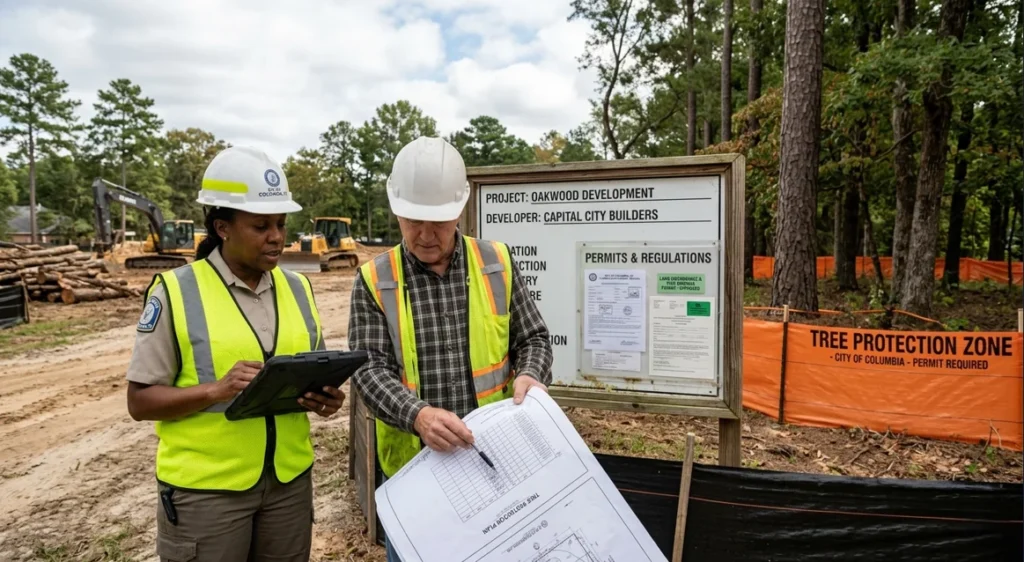
This is an area where many landowners get caught off guard, and the consequences of skipping required approvals can be genuinely expensive.
The City of Columbia’s Planning and Development Services department administers the city’s Landscape and Tree Ordinance, which requires a tree protection plan and a tree removal permit for most non single family residential clearing activities. If you are clearing a parcel for commercial development, a multi-unit residential project, or any site preparation that involves construction, filling, demolition, grading, or timber harvesting on property inside the city limits, you need to work through this process before work begins.
For work on private single-family residential lots within the city, the permit requirements are different and generally less burdensome, but the city’s Forestry and Beautification Division under Public Works may still need to be consulted for properties with trees in or near public rights-of-way.
Outside city limits in unincorporated Richland County, the Richland County Planning Department administers land use regulations, and clearing projects tied to development activity typically need to satisfy the county’s stormwater management ordinance through a Stormwater Pollution Prevention Plan, commonly known as a SWPPP, for disturbed areas over one acre.
Properties near streams, floodplains, or wetlands are regulated by DHEC’s Bureau of Water. Any land clearing that affects waters of the state or regulated wetlands requires a DHEC permit under Section 401 of the Clean Water Act, and in some cases a federal Section 404 permit from the U.S. Army Corps of Engineers. This applies to land along the Congaree, Saluda, Broad, and Wateree Rivers as well as numerous smaller tributaries throughout Richland and Lexington Counties.
The South Carolina Forestry Commission regulates timber harvesting activity and has oversight over burning on cleared land. If your disposal plan involves burning debris, you need to comply with the Commission’s notification and permit requirements, including maintaining firebreaks and having appropriate suppression equipment on hand.
Working with a contractor who knows the local regulatory landscape, including the City of Columbia, Richland County Planning, DHEC, and the Forestry Commission, is one of the most practical things you can do to avoid costly delays and fines. Many reputable Columbia-area land clearing companies handle permit coordination as part of their service.
How Long Does It Take to Clear an Acre in Columbia, SC
Timeline estimates depend heavily on the method used and vegetation density. A professional forestry mulching crew operating modern equipment can typically handle two to four acres per day on moderately vegetated land. A heavily wooded acre with large trees and dense undergrowth might take an entire day for a single acre.
Traditional excavator and bulldozer clearing on a moderate residential lot typically runs one to three days, including stump removal and initial grading. Commercial projects covering five or more acres may run one to two weeks, depending on scope and debris management requirements.
Clearing during South Carolina’s drier months, generally late summer through early winter, tends to be faster because equipment does not bog down in wet clay soil. Spring clearing on Columbia’s clay-heavy Piedmont soils can be slower and may cause more turf disturbance when equipment sinks into rain-saturated ground.
How to Save Money on Land Clearing in Columbia, SC
Get written quotes from at least three companies before committing to any clearing project. The spread between quotes for the same project in the Columbia market can be $1,000 or more per acre depending on each company’s equipment, overhead structure, and current workload.
Choose on-site mulching where possible. If your project does not require full stump extraction and your end use of the land is compatible with a mulch layer on the surface, forestry mulching keeps costs down significantly by eliminating haul-off fees.
Bundle clearing with grading if you need both. Companies that handle both services in a single mobilization can offer better pricing than booking two separate contractors. County Line Land Management and Bright LLC in Columbia both handle end-to-end site preparation including clearing, grading, and excavation.
Be transparent about what is on your land when getting quotes. Accurate descriptions of vegetation density, tree sizes, and access conditions produce accurate quotes. Surprises on site day cost time and usually end up being charged to you regardless.
Timing matters less in Columbia than in northern climates, but clearing during summer and fall when crews are busy can mean longer scheduling waits. If your project is not time-sensitive, late fall and winter in the Columbia area tend to come with faster scheduling and occasionally better pricing.
What the Clearing Quote Should Include
Before signing any contract for land clearing in Columbia, confirm the following in writing: what method will be used, what the acreage or total scope of work covers, whether debris will be mulched in place or hauled off and at whose cost, whether stump grinding is included in the base price or separate, what cleanup will look like at completion, and whether permit coordination is included or your responsibility.
Companies serving the Columbia market that are worth researching include R and T Grading in Pelion, Tri-County Land Services covering Lexington and surrounding counties, County Line Land Management, On The Rock Land Services, Bright LLC, and specialized forestry mulching operators across Richland and Lexington Counties. Asking for local references, confirming general liability insurance, and verifying that the crew has experience with Columbia’s specific soil types and regulatory environment is time well spent before a machine touches your property.
Final Thoughts
Land clearing cost per acre in Columbia, SC, is not a single number. It is a range determined by what is on the land, how the debris will be handled, what the end use of the property requires, and which regulatory approvals apply to your specific parcel. For a standard residential clearing project in the Midlands, budgeting $1,500 to $3,500 per acre as a starting estimate for moderate vegetation is a reasonable working number, with the understanding that heavily wooded land, wetland-adjacent parcels, or projects requiring full grading will land higher.
If you are in Columbia, Lexington, Irmo, Blythewood, Chapin, West Columbia, Cayce, or anywhere across the greater Midlands area and need a land clearing assessment, Tree Removal Columbia SC Pros provides free on-site estimates with transparent pricing and no hidden fees. Call (803) 770-6414 to schedule your site evaluation today.
Share: