Why Columbia SC Homeowners Need to Understand This Coverage
Columbia sits in a part of South Carolina that sees intense summer thunderstorms, occasional ice events in winter, and the outer bands of Atlantic hurricanes. The Midlands region is also home to an abundance of mature hardwoods — oaks, pines, sweet gums, and tulip poplars — that tower over neighborhoods from Forest Acres to Irmo, Lexington to Northeast Columbia.
When a 60-foot pine comes down during a storm, the last thing you want is confusion about who pays. Understanding the relationship between your homeowners policy and professional tree removal services is essential for every Columbia area property owner.
When Homeowners Insurance Does Cover Tree Removal in Columbia, SC
Insurance companies look at two main things when a tree falls: what caused it to fall, and what it landed on. Both factors must work in your favor for a claim to go through.
The Tree Damaged a Covered Structure
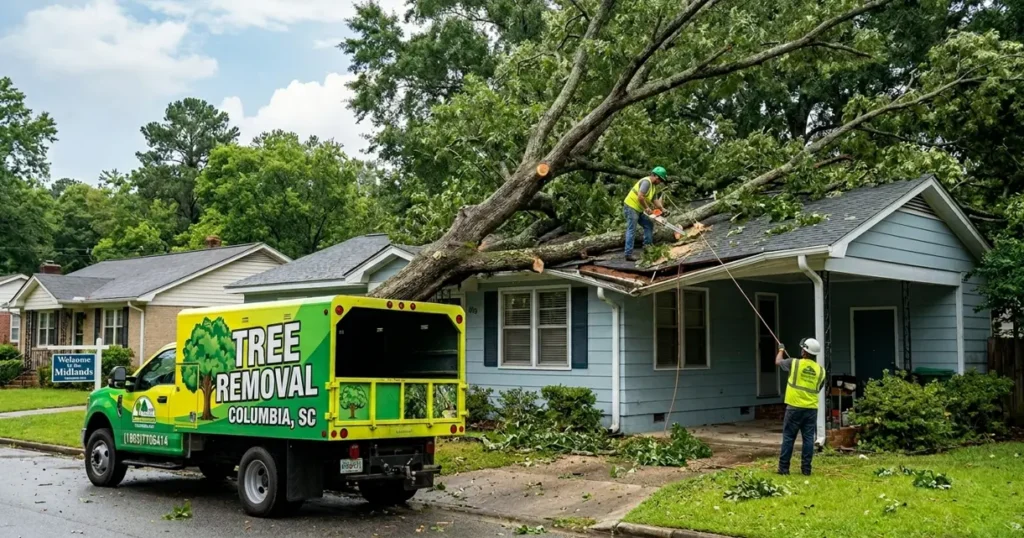
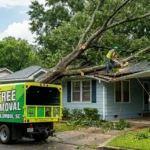
This is the most important factor. If a fallen tree or large limb damages your home, detached garage, shed, deck, fence, or another insured structure on your property, your homeowners policy will typically cover the cost of removing the tree as part of the overall damage claim. The debris removal and the structural repair are usually bundled together in that scenario.
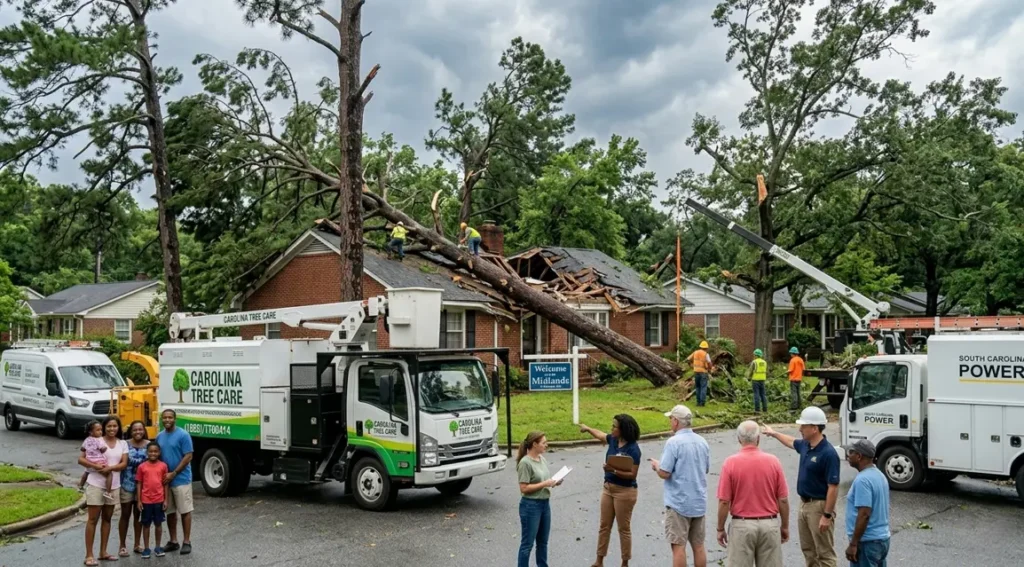
If you are dealing with a tree that came down during a severe storm and struck your home, reaching out to a professional emergency tree removal team right away is critical, both for safety and for preserving your insurance claim.
A Covered Peril Caused the Fall
Your insurance company also needs to confirm that the cause of the tree falling was a covered peril. Standard homeowners policies in South Carolina typically cover damage caused by wind, lightning strikes, hail, the weight of ice or snow, and fire. If the storm knocked your tree down and it hit your house, you are generally in good shape to file a claim.
What is not covered? Trees that fell due to rot, disease, pest infestation, flooding, or earthquake. Insurers treat these as maintenance issues or excluded natural events rather than sudden unforeseen losses.
The Tree Is Blocking Your Driveway or an Accessibility Ramp
Many policies include a clause that covers tree removal when a fallen tree is blocking your driveway or a mobility accessibility ramp, even if it did not strike a structure directly. This provision acknowledges that an inaccessible home is still a serious problem that deserves coverage. Coverage limits in these cases tend to be lower, so check your specific policy language.
Your Neighbor’s Tree Falls on Your Property
This is one of the most common points of confusion for homeowners in Columbia. If a tree from a neighboring property falls onto your home or outbuildings and was caused by a covered peril, your own homeowners insurance is typically the first to respond. Your insurer may then pursue reimbursement from your neighbor’s liability policy if negligence can be proven, for example, if your neighbor was aware the tree was dead or visibly diseased and failed to address it.
In most cases, negligence is difficult to prove, and both insurers work it out on the back end. The key takeaway is that your policy protects you even when the tree is not yours.
When Homeowners Insurance Does NOT Cover Tree Removal
Knowing the exclusions is just as important as knowing the coverage. Columbia homeowners are sometimes surprised to learn how often claims get denied in tree-related situations.
Preventative or Routine Tree Removal
If a tree on your property is leaning, looks unhealthy, or is simply getting too large for your yard, your insurance will not pay to remove it preemptively. Preventative removal is considered routine property maintenance, which falls entirely on the homeowner. This is true even if the tree is clearly a future risk.
The good news is that getting ahead of hazardous trees before they cause damage is almost always less expensive than dealing with the aftermath. A hazardous tree removal professional can assess the risk and remove the threat before it becomes a costly insurance situation.
The Tree Fell but Did Not Hit Anything
A tree that falls in an open part of your yard during a storm and misses your home, fence, and all other structures is generally not covered for debris removal under a standard policy. You are responsible for removing it even if it came down in dramatic fashion. Some insurers offer limited debris removal coverage in these situations, but it is far from standard and often carries a very low cap.
The Tree Was Dead, Rotting, or Neglected
Insurers routinely investigate whether a tree showed visible signs of decay, disease, or structural weakness before it fell. If your adjuster determines the tree was already dead or was clearly deteriorating before the storm, your claim may be denied on grounds of owner negligence. This is why regular property inspections matter. Identifying and removing a compromised tree before a storm is not only safer, it protects your coverage rights.
Flooding, Earthquakes, and Other Excluded Perils
Standard homeowners policies in South Carolina do not cover flood damage, and that extends to trees. If heavy rains saturate the soil and uproot a tree onto your home during a flooding event, the cause of the loss may be classified as flood rather than wind, which could result in a denial unless you have a separate flood insurance policy through the National Flood Insurance Program or a private carrier.
How Much Will Insurance Pay for Tree Removal in Columbia, SC?
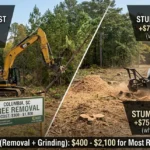
Even when your claim is approved, your coverage has limits. Most standard homeowners policies in South Carolina cap debris removal at around $500 per tree and $1,000 per incident. Given that professional tree removal in the Columbia metro area can run anywhere from $400 to over $2,000 depending on the size, species, and location of the tree, you may still face out-of-pocket costs after the insurance payout.
Your deductible also plays a significant role. If the total damage from the fallen tree comes in under your deductible, which commonly sits between $1,000 and $2,500, filing a claim may not make financial sense. In some cases, paying for the removal directly and skipping the claim altogether is the smarter move, since a filed claim can affect your future premium rates.
For a large tree that requires specialized equipment, the cost can be substantially higher. The large crane-assisted tree removal services that complex jobs demand are not inexpensive, and that should factor into your conversation with your insurance agent about coverage limits.
What to Do Immediately After a Tree Falls on Your Property in Columbia
Acting quickly and methodically after a tree event can make a real difference in how smoothly your insurance claim moves forward.
The first priority is safety. Keep your family away from the area, especially if the tree has come into contact with power lines or has compromised a wall or roof. Contact your utility company and emergency services if needed before anything else.
Next, document everything. Before any cleanup begins, take extensive photos and video of the fallen tree, all visible damage to your structures, and the surrounding area. Date-stamp everything. Your insurer will want this evidence when you file your claim.
Then call your insurance company. Report the incident as soon as possible and ask specifically what documentation they require. Ask about your debris removal limit, your deductible, and whether you need a licensed contractor to provide a repair estimate before work begins.
Finally, contact a certified arborist or professional tree service. Do not attempt to remove a large fallen tree yourself, particularly one that is resting on your roof or in contact with a structure. Tree Removal Columbia can assess the situation, provide documentation your insurer may request, and handle the removal safely and professionally.
South Carolina-Specific Insurance Considerations Columbia Homeowners Should Know
South Carolina is a coastal state with significant weather exposure, and that shapes the local insurance landscape in important ways. Many insurers in the state write separate wind and hail deductibles that are higher than your standard deductible, sometimes calculated as a percentage of your home’s insured value rather than a flat dollar amount. If your home is insured for $300,000 and your wind deductible is 1%, that is $3,000 out of pocket before coverage kicks in.
This percentage-based deductible structure is especially common in counties with elevated hurricane risk. While Columbia is inland, some policies written in South Carolina apply wind deductibles statewide. Review your declarations page carefully, and if you are unsure, call your agent before you are in the middle of a crisis.
It is also worth noting that high-humidity conditions in the Midlands accelerate wood decay in trees. A tree that looks fine from the outside may have significant internal rot. Regular inspections by a licensed arborist help you stay ahead of this risk and keep your landscaping healthy enough that an insurer cannot cite negligence if something falls during a storm.
Neighbor Disputes Over Fallen Trees in Columbia, SC
Property line tree disputes are not uncommon in established Columbia neighborhoods, and understanding the legal framework matters. South Carolina generally follows a principle that holds each property owner responsible for the trees on their own land. If your neighbor’s healthy tree falls on your property during a storm, your own insurance typically handles the claim.
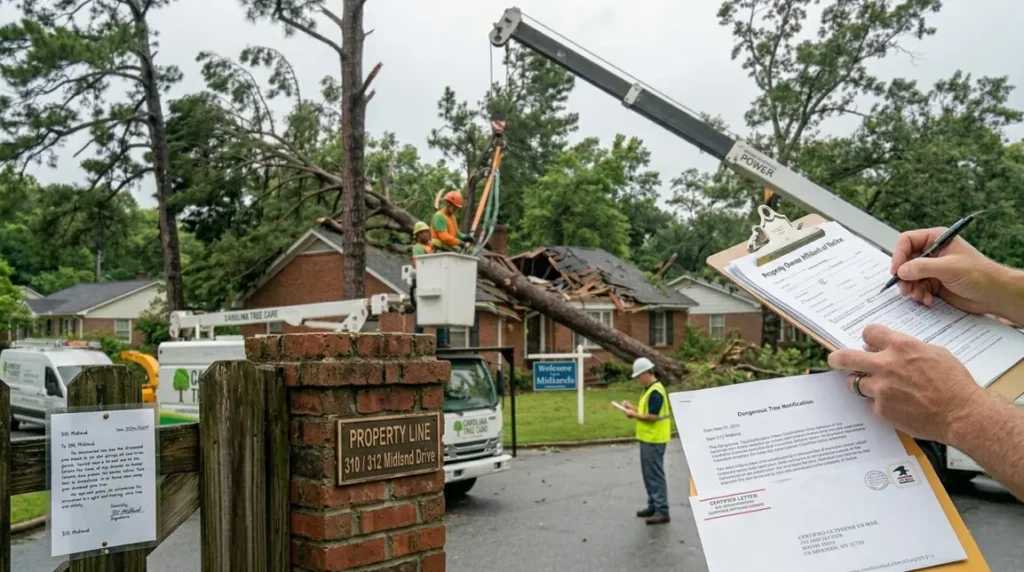
However, if you have documented evidence that a tree was visibly dead, diseased, or structurally unsafe and you notified your neighbor in writing before it fell, there is a stronger basis for a negligence claim against their liability coverage. Sending a certified letter or written notice to your neighbor when you observe a dangerous tree near the property line is something Columbia homeowners would be wise to do proactively.
What About Stump Removal After a Covered Tree Claim?
This is a detail many homeowners overlook until after the fact. Stump removal is usually not included in a standard tree removal insurance claim. Your policy may cover the felling and clearing of the fallen tree that caused the damage, but the remaining stump is typically considered a separate expense once the tree is cut.
If you are already having professional work done on your property after a storm event, bundling your stump removal with the overall project is usually more cost-effective than scheduling it separately later.
Land Clearing After Storm Damage: What Is and Is Not Covered
Large storms can sometimes leave more than just one or two trees down. If your Columbia property experiences widespread tree damage, especially on larger lots, wooded buffers, or rural land, you may be looking at significant land clearing work that goes well beyond what a standard policy covers.
In these cases, only the trees that directly damaged an insured structure will likely be covered under your homeowners claim. The broader clearing of downed timber, brush, and debris throughout your property will generally be an out-of-pocket expense. Understanding this distinction helps you set realistic expectations before your adjuster arrives.
Tree Removal Coverage for Lexington, SC Homeowners
Homeowners in Lexington County face similar weather patterns and insurance considerations as those in Richland County, with the added dynamic of lakeside properties on Lake Murray where storms can be especially intense. If you are in Lexington and dealing with a fallen tree situation, the same insurance rules apply. The peril, the structure, and the condition of the tree are what your adjuster will focus on. Local Lexington SC tree removal services familiar with the area can help you respond quickly and document everything your insurer needs.
Tips for Protecting Your Coverage Rights Year-Round
You do not have to wait for a storm to take smart steps that protect both your property and your insurance position.
Schedule an annual tree inspection with a certified arborist, particularly for any large trees within striking distance of your home or other structures. Keep a written record of the inspection and any work performed. This documentation can be invaluable if a future claim is contested.
Trim branches that overhang your roof, gutters, and HVAC equipment on a regular basis. Overhanging limbs are one of the most common causes of storm-related roofing damage in the Columbia area.
Review your homeowners policy at each renewal. Ask your agent specifically about debris removal limits, wind deductibles, and whether any endorsements are available to increase your tree-related coverage.
Maintain open communication with your neighbors about trees that concern you on either side of the property line. A friendly conversation is far less stressful than a post-storm legal dispute.
Final Thought: When in Doubt, Call a Professional First
Insurance adjusters make their assessments based on the evidence they see, which means the condition of your property and how quickly you respond both matter. When a tree comes down on your Columbia area home, getting a licensed tree professional on-site quickly serves two purposes: it keeps your family safe, and it ensures the situation is properly documented before anything changes.
Tree Removal Columbia works with homeowners across the Midlands and Lexington County to handle everything from routine removals to complex storm response, helping you navigate both the physical cleanup and the insurance process with confidence.